
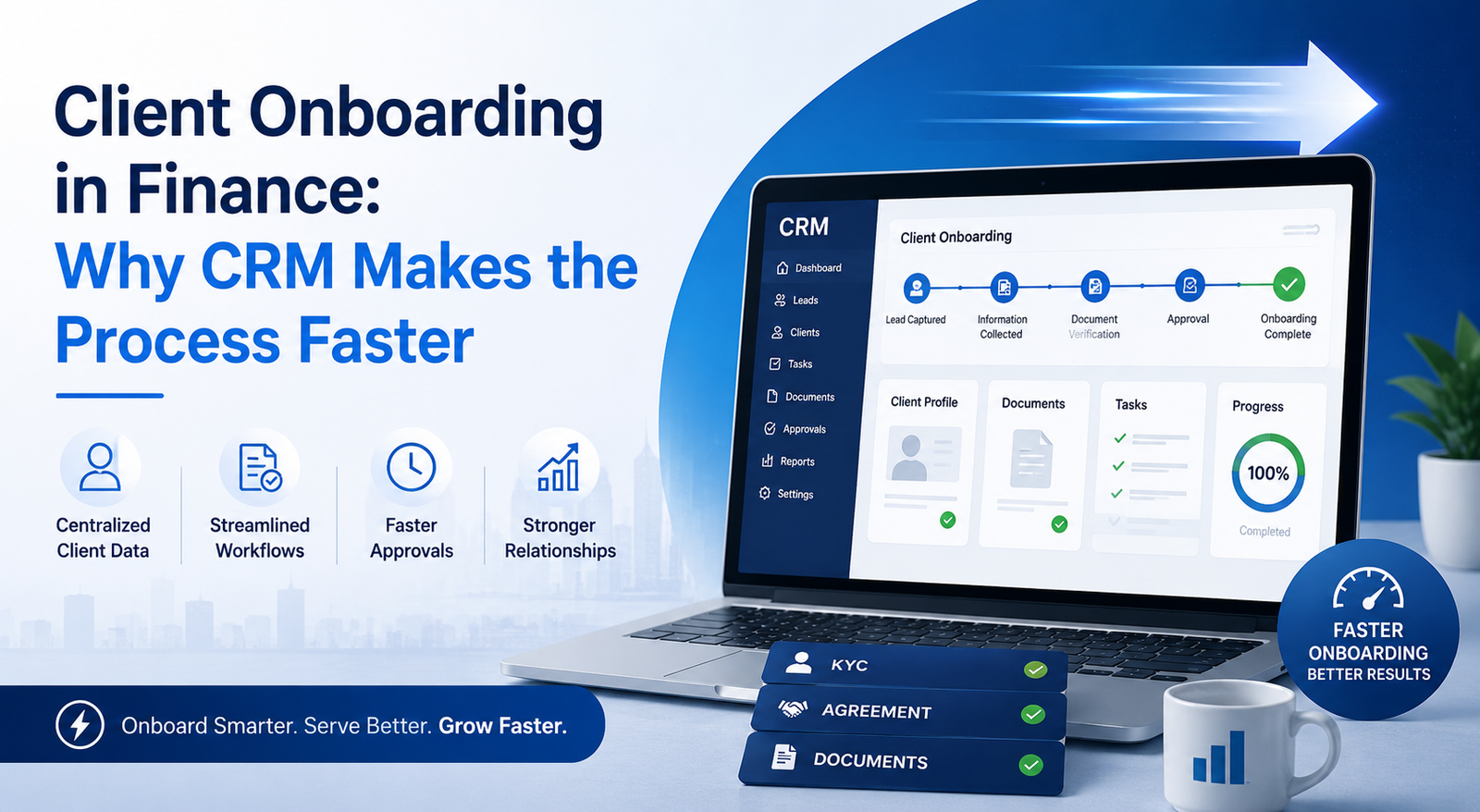
Manual onboarding slows financial growth. Learn how CRM software simplifies document collection, follow-ups, and onboarding workflows.
Client onboarding is one of the most critical stages in the financial services industry. Whether you are a financial advisor, insurance consultant, wealth manager, mortgage broker, or accounting firm, the onboarding experience shapes the client’s first impression of your business.
Yet many finance companies still rely on spreadsheets, emails, paper forms, and disconnected systems to manage onboarding. This creates delays, confusion, compliance risks, and frustrated clients.
A modern CRM changes that completely.
A financial CRM centralizes client information, automates repetitive tasks, improves communication, and streamlines compliance workflows. The result is faster onboarding, better client satisfaction, and more efficient operations.
In this blog, we’ll break down how CRM software speeds up client onboarding in finance and why firms that adopt CRM systems gain a major competitive advantage.
What Is Client Onboarding in Finance?
Client onboarding is the process of collecting, verifying, and organizing all information needed before delivering financial services to a new client.
This process typically includes:
- Collecting personal and financial information
- Completing KYC (Know Your Customer) procedures
- Identity verification
- Risk assessment
- Document submission
- Compliance checks
- Agreement signing
- Account setup
- Communication and follow-ups
For financial firms, onboarding is more than just paperwork. It is a compliance-heavy process that directly impacts operational efficiency and customer trust.
If onboarding takes too long, clients may lose confidence before the relationship even begins.
The Biggest Problems With Traditional Client Onboarding
Many finance businesses still manage onboarding manually. While this may work for a small client base, it quickly becomes inefficient as the business grows.
Here are some common onboarding challenges financial firms face:
1. Too Much Manual Data Entry
Employees often enter the same client information into multiple systems. This increases the chances of human error and wastes valuable time.
2. Lost or Disorganized Documents
Documents sent through email chains can easily get misplaced. Teams struggle to track which files are pending or completed.
3. Slow Client Communication
Without centralized communication, clients constantly ask for updates. Delayed responses reduce trust and satisfaction.
4. Compliance Risks
Missing KYC documents or incomplete verification steps can create serious regulatory issues.
5. Lack of Visibility
Managers cannot easily track where each client is in the onboarding process.
How CRM Makes Client Onboarding Faster
A CRM system streamlines onboarding by automating workflows and centralizing information.
Here’s how it improves the process.
1. Centralized Client Information
A CRM stores all client details in one place.
Instead of switching between spreadsheets, emails, and folders, advisors can access:
- Contact details
- Financial history
- Uploaded documents
- Communication records
- Compliance status
- Meeting notes
- Task updates
This reduces confusion and eliminates duplicate work.
When everyone on the team works from the same system, onboarding moves much faster.
2. Automated Data Collection
Modern CRMs allow firms to create digital onboarding forms that clients can complete online.
Instead of printing and scanning paperwork, clients can:
- Fill forms digitally
- Upload documents securely
- Submit identification
- Sign agreements electronically
The CRM automatically stores and organizes the information.
This dramatically reduces onboarding delays and manual administration.
3. Faster KYC and Compliance Processes
Compliance is one of the most time-consuming parts of financial onboarding.
A CRM helps automate compliance workflows by:
- Creating document checklists
- Sending automatic reminders
- Tracking missing requirements
- Recording verification steps
- Maintaining audit trails
Many financial CRMs also integrate with identity verification and AML screening tools.
This helps firms complete compliance procedures faster while reducing regulatory risk.
4. Workflow Automation
One of the biggest advantages of CRM software is automation.
Instead of manually assigning tasks, the CRM automatically triggers actions based on onboarding stages.
For example:
- After a client submits documents, the compliance team gets notified
- Once KYC is approved, account setup begins automatically
- Advisors receive reminders for follow-ups
- Clients get status update emails instantly
Automation removes bottlenecks and speeds up the entire onboarding journey.
5. Improved Client Communication
Clients want transparency during onboarding.
A CRM keeps communication organized through:
- Automated email updates
- Appointment reminders
- Follow-up notifications
- Shared communication history
- Client portals
This prevents clients from feeling ignored or confused.
Better communication leads to higher trust and a smoother onboarding experience.
6. Electronic Document Management
Paper-based onboarding slows everything down.
A CRM provides secure digital document management where firms can:
- Upload files
- Share documents securely
- Request signatures
- Track document status
- Store compliance records
This makes onboarding faster while improving data security.
7. Better Team Collaboration
Finance firms often involve multiple departments during onboarding.
These may include:
- Sales teams
- Financial advisors
- Compliance officers
- Account managers
- Operations teams
A CRM ensures everyone can see onboarding progress in real time.
This eliminates communication gaps and prevents duplicated efforts.
8. Faster Response Times
Clients expect quick service.
Without CRM software, delays happen because staff members need to search emails, documents, or spreadsheets manually.
A CRM allows teams to instantly access client information and respond faster.
This creates a more professional experience and improves client retention.
9. Scalable Onboarding Process
As financial firms grow, onboarding volume increases.
Manual systems cannot scale efficiently.
A CRM allows businesses to onboard more clients without dramatically increasing administrative workload.
This is especially important for:
- Wealth management firms
- Insurance agencies
- Mortgage companies
- Investment advisors
- Accounting firms
- Fintech businesses
Scalable onboarding helps businesses grow without sacrificing service quality.
10. Better Client Experience
A smooth onboarding experience creates stronger client relationships from day one.
Clients appreciate:
- Faster approvals
- Digital convenience
- Clear communication
- Reduced paperwork
- Secure document sharing
When onboarding feels simple and professional, clients are more likely to trust your business long term.
Key CRM Features That Improve Financial Onboarding
When choosing a CRM for financial services, look for features such as:
Workflow Automation
Automates repetitive onboarding tasks and approvals.
Document Management
Stores and organizes files securely.
E-signature Integration
Allows digital contract signing.
Compliance Tracking
Helps manage KYC and AML requirements.
Client Portals
Provides clients with secure access to onboarding updates.
Task Management
Tracks onboarding activities and deadlines.
Email Automation
Sends reminders and status updates automatically.
Reporting and Analytics
Measures onboarding performance and bottlenecks.
Industries That Benefit Most From CRM Onboarding
Many financial sectors benefit from CRM-driven onboarding, including:
- Financial advisory firms
- Insurance agencies
- Mortgage brokers
- Investment firms
- Tax consultants
- Accounting firms
- Credit unions
- Banks
- Fintech startups
Any finance business handling client data and compliance workflows can improve efficiency with CRM software.
Real Business Impact of Faster Onboarding
Faster onboarding delivers measurable benefits.
Increased Client Satisfaction
Clients value speed and transparency.
Higher Conversion Rates
Prospects are less likely to abandon the process.
Reduced Administrative Costs
Automation lowers manual workload.
Better Compliance Management
Structured workflows reduce compliance risks.
Improved Productivity
Teams spend less time on repetitive tasks.
Stronger Client Retention
Positive onboarding experiences improve long-term relationships.
Signs Your Finance Business Needs a CRM
Your onboarding process may need a CRM if:
- Clients complain about delays
- Staff manually enters data repeatedly
- Documents get lost in emails
- Compliance tracking feels difficult
- Teams struggle with communication
- Onboarding takes days or weeks
- Follow-ups are inconsistent
If these issues sound familiar, CRM software can significantly improve operations.
