
Find out how CRM platforms help financial institutions identify opportunities, improve customer insights, and boost cross-selling success.
Cross-selling has always been one of the most profitable growth strategies for financial firms. When a client already trusts your company for one service, offering additional relevant solutions becomes much easier and more cost-effective than acquiring a brand-new customer.
But in reality, many financial firms struggle with cross-selling because client data is scattered across spreadsheets, emails, call notes, and disconnected systems. Advisors miss opportunities simply because they lack visibility into client needs, financial goals, and engagement history.
This is where Customer Relationship Management software changes the game.
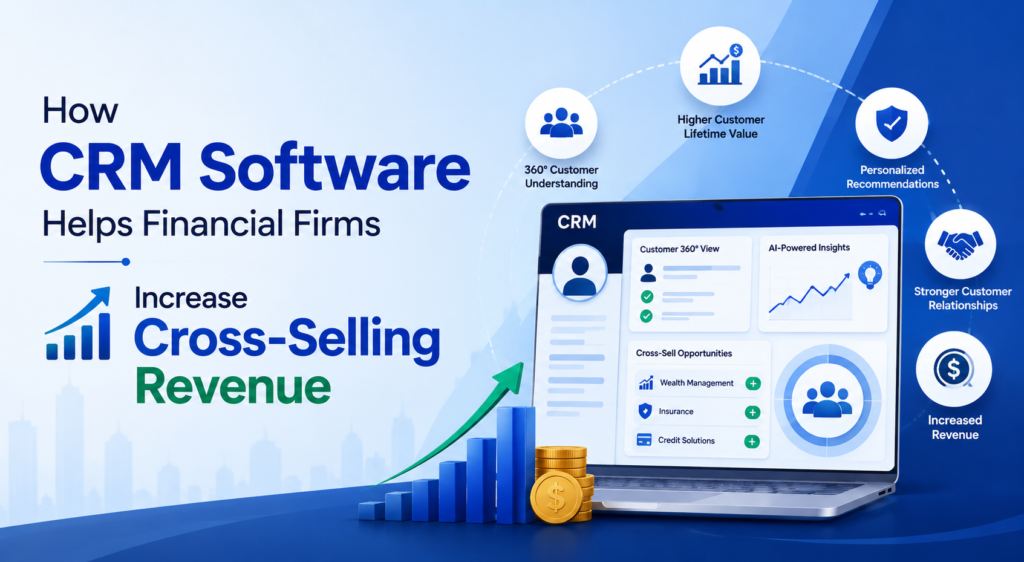
Modern CRM systems help financial firms centralize client data, identify opportunities, automate follow-ups, and deliver personalized recommendations at the right time. Instead of relying on guesswork, advisors can make data-driven decisions that naturally lead to higher cross-selling revenue.
In this blog, we’ll explore how CRM software helps financial firms improve client relationships and increase revenue through smarter cross-selling strategies.
What Is Cross-Selling in Financial Services?
Cross-selling in the financial industry means offering additional financial products or services to existing clients based on their needs and financial situation.
Examples include:
- A wealth management client purchasing insurance services
- A mortgage customer opening an investment account
- A business banking client using payroll services
- A tax advisory client subscribing to retirement planning
- An investor purchasing estate planning solutions
Cross-selling works best when recommendations are timely, personalized, and relevant. Clients do not want generic sales pitches. They expect financial firms to understand their goals and provide meaningful guidance.
That level of personalization becomes difficult without a CRM platform.
Why Financial Firms Struggle With Cross-Selling
Many financial advisors and firms still face major operational gaps that reduce cross-selling success.
Common challenges include:
Fragmented Client Information
Client records often exist in multiple systems, making it hard to get a complete view of relationships, assets, communication history, and financial goals.
Missed Follow-Ups
Without automated reminders and workflows, advisors forget renewal dates, policy expirations, investment milestones, or life-event opportunities.
Lack of Personalization
Generic outreach rarely converts. Financial clients expect personalized recommendations based on their financial behavior and priorities.
Poor Team Collaboration
When relationship managers, advisors, and support teams work in silos, valuable cross-selling opportunities are lost.
Limited Data Insights
Without analytics, firms cannot identify which clients are most likely to purchase additional services.
CRM software addresses all these issues in one centralized system.
How CRM Software Increases Cross-Selling Revenue
1. Creates a Complete Client Profile
A CRM platform stores all client information in one place, including:
- Contact details
- Financial goals
- Investment history
- Risk tolerance
- Insurance policies
- Loan records
- Communication history
- Meeting notes
- Document history
With a 360-degree client view, advisors can quickly identify gaps in a client’s financial strategy and recommend suitable services.
For example:
If a client recently increased their investment portfolio significantly, the advisor may recommend estate planning or tax optimization services.
The more complete the client profile, the more accurate and effective the cross-selling process becomes.
2. Identifies High-Value Cross-Selling Opportunities
CRM software helps firms analyze client behavior and identify revenue opportunities automatically.
Advanced CRM systems can:
- Detect clients approaching retirement
- Identify inactive investment accounts
- Highlight clients without insurance coverage
- Track large account deposits
- Monitor portfolio changes
- Analyze client engagement levels
Instead of manually reviewing hundreds of accounts, advisors receive smart recommendations and alerts.
This improves both efficiency and conversion rates.
3. Improves Personalized Communication
Personalization is critical in financial services.
Clients are far more likely to respond when advisors communicate based on individual needs and financial goals.
CRM platforms help firms personalize:
- Email campaigns
- Investment recommendations
- Meeting reminders
- Financial planning updates
- Product offers
- Educational content
For example:
A CRM can automatically send retirement planning content to clients above a certain age or investment threshold.
This creates trust while positioning the firm as a proactive financial advisor rather than a sales-driven organization.
4. Automates Follow-Ups and Lead Nurturing
Timing matters in financial cross-selling.
A missed follow-up can mean losing a major revenue opportunity.
CRM software automates:
- Follow-up reminders
- Appointment scheduling
- Renewal notifications
- Birthday and milestone communications
- Lead nurturing sequences
- Policy expiration alerts
Automation ensures that no opportunity slips through the cracks.
It also reduces administrative workload, allowing advisors to focus more on relationship-building and revenue generation.
5. Tracks Client Life Events
Major life events often create new financial needs.
CRM software helps advisors track important milestones such as:
- Marriage
- Retirement
- New business launches
- Property purchases
- Birth of a child
- Career changes
- Inheritance events
These moments create natural opportunities for cross-selling financial products and services.
For example:
A client purchasing a new home may also need mortgage protection insurance, investment restructuring, or tax planning services.
CRM systems make it easier to identify and act on these opportunities quickly.
6. Enhances Advisor Productivity
Financial advisors spend a significant amount of time on manual administrative tasks.
CRM software streamlines operations through:
- Workflow automation
- Centralized document management
- Digital note-taking
- Task tracking
- Automated reporting
- Integrated communication tools
With less time spent on repetitive tasks, advisors can focus more on strategic conversations and client engagement.
Higher advisor productivity often leads directly to increased cross-selling performance.
7. Strengthens Client Retention
Cross-selling becomes easier when clients trust your firm.
CRM systems help strengthen long-term relationships by improving responsiveness, personalization, and service quality.
Satisfied clients are more likely to:
- Purchase additional services
- Consolidate financial accounts
- Refer new clients
- Stay loyal to the firm
Retention and cross-selling are closely connected. The longer a client relationship lasts, the greater the revenue potential.
8. Provides Data-Driven Insights and Reporting
Modern CRM platforms include advanced analytics and reporting tools.
Financial firms can monitor:
- Cross-selling conversion rates
- Revenue per client
- Advisor performance
- Client engagement levels
- Product adoption trends
- Campaign effectiveness
These insights help firms optimize their sales strategies and identify which services generate the highest return.
Instead of relying on assumptions, leadership teams can make informed growth decisions backed by real data.
Key CRM Features Financial Firms Should Look For
Not all CRM systems are designed for financial services.
When selecting a CRM, financial firms should prioritize features such as:
Financial Workflow Automation
Automation reduces manual work and improves operational efficiency.
Client Segmentation
Helps firms target clients with highly personalized offers.
Compliance and Security
Financial data security and regulatory compliance are essential.
Integration Capabilities
The CRM should integrate with:
- Portfolio management systems
- Accounting software
- Marketing platforms
- Banking systems
- Communication tools
Reporting and Analytics
Advanced reporting improves strategic decision-making.
Mobile Accessibility
Advisors should access client information securely from anywhere.
Real-World Example of CRM Cross-Selling Success
Imagine a mid-sized financial advisory firm managing over 3,000 clients.
Before implementing CRM software:
- Advisors used spreadsheets for tracking
- Follow-ups were inconsistent
- Client data was incomplete
- Cross-selling opportunities were mostly reactive
After implementing a financial CRM platform:
- Client segmentation improved dramatically
- Automated reminders increased meeting frequency
- Personalized recommendations boosted client engagement
- Advisors identified more investment and insurance opportunities
Within one year, the firm increased cross-selling revenue by over 30% while improving client retention rates.
This type of growth is becoming increasingly common among firms adopting CRM technology.
The Future of CRM in Financial Services
CRM platforms are rapidly evolving with technologies like:
- Artificial intelligence
- Predictive analytics
- Behavioral scoring
- Automated financial recommendations
- Conversational AI
- Advanced client intelligence
Future CRM systems will become even more proactive in identifying cross-selling opportunities before advisors manually detect them.
Financial firms that adopt modern CRM strategies early will gain a major competitive advantage.
