
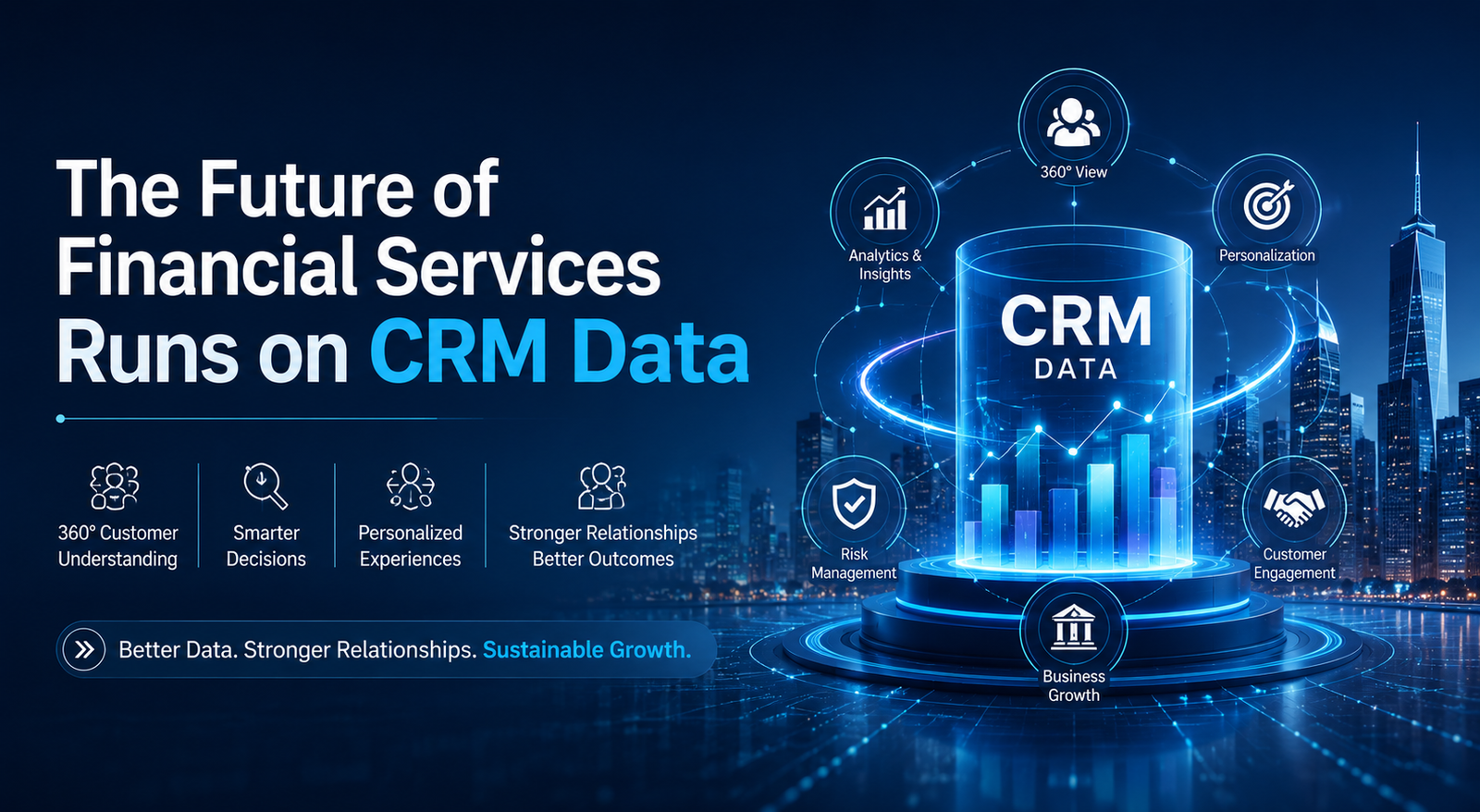
Data-driven finance is growing fast. Discover how CRM systems help financial firms make smarter decisions using real-time client insights.
Financial services have changed dramatically over the last decade. Customers expect faster responses, personalized experiences, seamless communication, and proactive financial guidance. At the same time, financial institutions face growing competition, tighter regulations, and increasing pressure to improve operational efficiency.
In this environment, data has become one of the most valuable assets in the industry. But raw data alone is not enough. The real advantage comes from how financial organizations collect, organize, analyze, and act on customer information. That is where CRM data becomes critical.
Modern CRM platforms are no longer just digital address books or sales tracking systems. They have evolved into intelligent ecosystems that power customer relationships, automate workflows, improve compliance, and drive revenue growth. The future of financial services runs on CRM data because it gives firms the ability to understand customers deeply and deliver smarter financial experiences at scale.
What CRM Data Means in Financial Services
CRM data includes every interaction and detail connected to a client relationship. This may include:
- Contact information
- Investment preferences
- Communication history
- Financial goals
- Risk tolerance
- Loan applications
- Transaction patterns
- Customer support records
- Policy details
- Behavioral insights
- Meeting notes
- Compliance documents
For banks, wealth management firms, insurance providers, mortgage companies, and fintech businesses, this information becomes the foundation for better decision-making.
Instead of operating with disconnected spreadsheets and siloed systems, financial firms can use CRM data to create a unified customer profile. That unified view changes everything.
Why CRM Data Is Becoming the Core of Financial Services
1. Personalized Financial Experiences Are the New Standard
Customers no longer accept generic financial services. They expect institutions to understand their needs, habits, and goals.
A CRM system helps financial advisors and institutions deliver highly personalized experiences by analyzing customer behavior and historical interactions.
For example:
- A wealth manager can recommend investment products based on a client’s risk profile.
- A bank can identify when a customer may need refinancing options.
- An insurance provider can suggest policy upgrades based on life events.
- A financial advisor can proactively reach out before important milestones.
This level of personalization builds trust and increases long-term client retention.
2. Better Customer Retention Through Predictive Insights
Client retention is one of the biggest priorities in financial services. Acquiring new customers is expensive, and losing high-value clients can significantly impact revenue.
CRM data helps firms identify warning signs before customers leave.
Advanced CRM systems can track:
- Reduced engagement
- Missed payments
- Declining account activity
- Negative support interactions
- Lower investment activity
Using predictive analytics, financial businesses can intervene early with personalized outreach and retention strategies.
Instead of reacting after losing a customer, firms can proactively strengthen relationships.
3. Smarter Sales and Cross-Selling Opportunities
Financial institutions often offer multiple services, including:
- Banking
- Insurance
- Investments
- Retirement planning
- Mortgages
- Credit products
CRM data helps teams identify cross-selling opportunities naturally and intelligently.
For example:
- A mortgage customer may also need life insurance.
- A business banking client may benefit from payroll solutions.
- A retirement planning client may require estate planning services.
Because CRM systems centralize customer information, teams can recommend relevant services instead of making random sales pitches.
This improves both conversion rates and customer satisfaction.
4. AI and Automation Depend on CRM Data
Artificial intelligence is rapidly transforming financial services. But AI systems are only as powerful as the data they receive.
CRM data fuels:
- AI-driven customer insights
- Automated follow-ups
- Smart recommendations
- Fraud detection
- Risk analysis
- Chatbots
- Predictive forecasting
- Customer segmentation
Without organized CRM data, AI tools cannot deliver accurate or useful results.
In the future, financial firms that maintain clean and structured CRM databases will gain a major competitive advantage because their AI systems will produce better predictions and smarter automation.
5. Improved Compliance and Risk Management
Regulatory compliance remains one of the biggest challenges in financial services.
CRM systems help firms maintain organized records for:
- Customer communications
- Consent tracking
- Document storage
- Audit trails
- KYC processes
- Financial disclosures
This reduces compliance risks and simplifies reporting requirements.
A centralized CRM platform also improves transparency across teams, helping firms avoid errors caused by fragmented systems.
As regulations continue evolving, firms with strong CRM infrastructure will adapt more efficiently.
6. Faster Decision-Making With Real-Time Data
Financial markets move quickly. Delayed information can lead to missed opportunities or increased risks.
CRM systems provide real-time access to customer data and business insights.
Teams can instantly view:
- Customer history
- Open cases
- Investment activity
- Sales pipelines
- Financial interactions
- Support tickets
This enables faster decisions and more responsive customer service.
For example, if a client contacts an advisor during market volatility, the advisor can immediately access the full relationship history and provide informed recommendations.
7. Stronger Collaboration Across Departments
Many financial organizations struggle with disconnected departments.
Sales teams, advisors, customer support, compliance officers, and marketing departments often work with separate systems and incomplete information.
CRM platforms create a shared source of truth.
When all teams access the same customer data:
- Communication improves
- Duplicate work decreases
- Errors are reduced
- Customer experiences become more consistent
This collaborative approach becomes increasingly important as financial services grow more digital and customer-centric.
How CRM Data Supports Different Financial Sectors
Banking
Banks use CRM data to:
- Improve customer onboarding
- Detect upselling opportunities
- Personalize digital banking experiences
- Automate customer support
- Reduce churn
Wealth Management
Wealth advisors rely on CRM systems to:
- Track investor goals
- Monitor portfolios
- Schedule client reviews
- Manage high-net-worth relationships
- Deliver tailored investment advice
Insurance
Insurance companies use CRM data for:
- Policy management
- Claims tracking
- Renewal reminders
- Customer engagement
- Fraud prevention
Mortgage and Lending
Mortgage providers use CRM platforms to:
- Automate lead nurturing
- Simplify loan processing
- Improve communication
- Track application progress
- Increase referral business
Fintech Companies
Fintech businesses depend heavily on CRM data to:
- Analyze customer behavior
- Improve app engagement
- Personalize financial tools
- Optimize user experiences
- Scale customer support
The Rise of Data-Driven Financial Relationships
Traditional financial services focused heavily on transactions. Modern financial services focus on relationships.
CRM data helps institutions move from reactive service models to proactive relationship management.
Instead of waiting for customers to ask for help, firms can:
- Anticipate financial needs
- Provide timely recommendations
- Identify opportunities earlier
- Improve customer education
- Build stronger trust
This relationship-driven approach will define the next generation of financial services.
Common Challenges Financial Firms Face With CRM Data
Despite the benefits, many organizations still struggle with CRM adoption.
Common challenges include:
Poor Data Quality
Incomplete or outdated information reduces CRM effectiveness.
Lack of Integration
Disconnected systems create data silos.
Low User Adoption
Employees may resist using CRM platforms if workflows are complicated.
Security Concerns
Financial data requires strong security and compliance measures.
Limited Analytics
Some firms collect data but fail to use it strategically.
To overcome these issues, financial institutions need clear CRM strategies, proper training, and strong data governance.
What the Future Looks Like
The future of financial services will become increasingly data-driven, automated, and personalized.
CRM systems will continue evolving with:
- Advanced AI integration
- Predictive analytics
- Real-time customer intelligence
- Voice and conversational interfaces
- Hyper-personalized financial recommendations
- Automated compliance monitoring
- Deeper fintech integrations
Financial firms that invest early in CRM infrastructure will be better positioned to compete in a rapidly changing market.
The organizations that win in the future will not simply collect customer data. They will know how to use it intelligently.
