
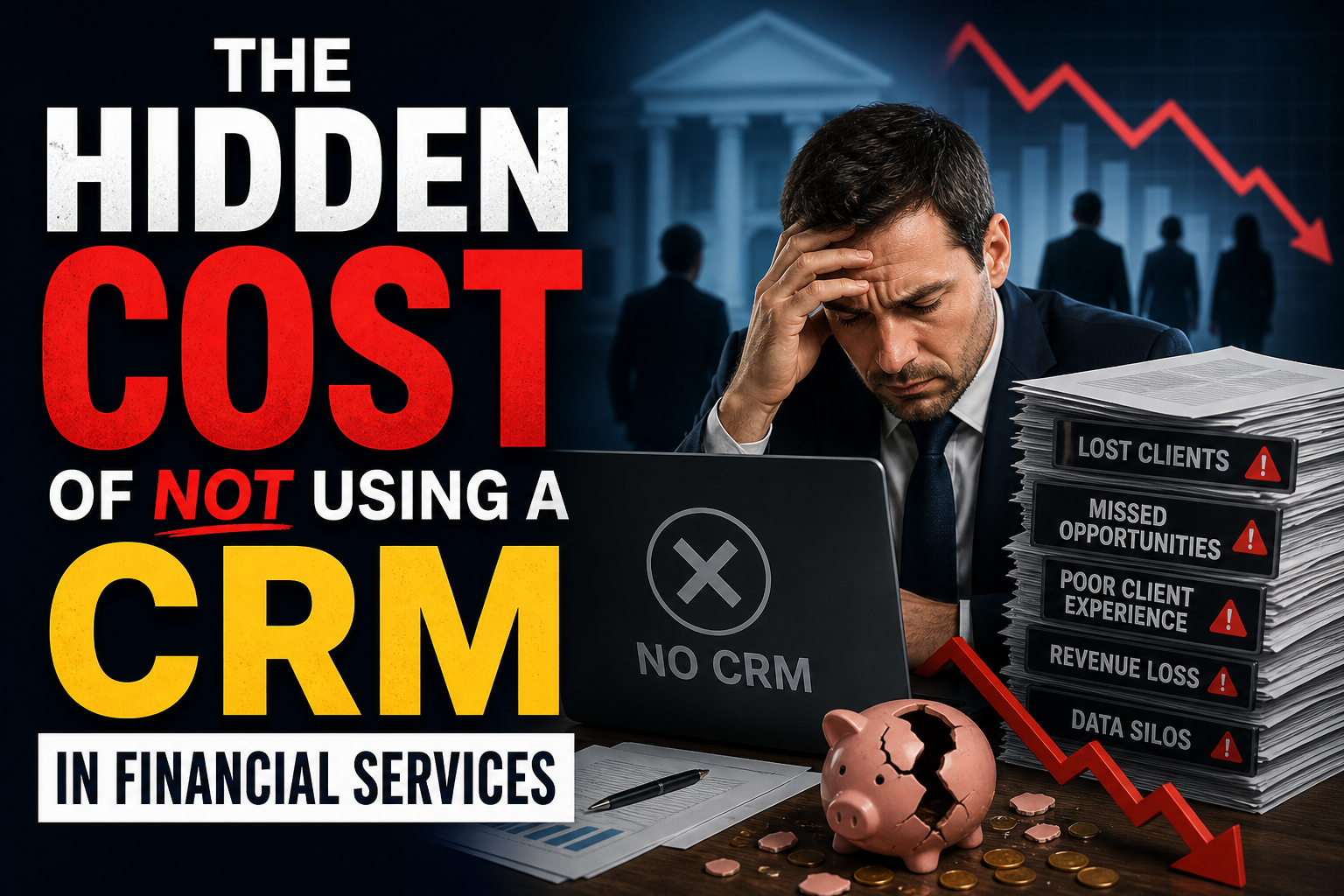
Not using a CRM can hurt your financial business. Learn the risks, missed opportunities, and revenue loss caused by outdated systems.
In financial services, relationships are everything. Whether you’re managing retail banking clients, high-net-worth individuals, or corporate accounts, your ability to track interactions, understand client needs, and respond quickly defines your success. Yet many firms still rely on spreadsheets, emails, or fragmented systems instead of a centralized CRM.
At first glance, skipping a CRM might seem like a cost-saving move. No licensing fees, no onboarding headaches, no system migration. But that’s a short-term view. The real cost of not using a CRM is hidden in lost opportunities, operational inefficiencies, compliance risks, and poor client experience.
Let’s break down where those costs show up and why they matter.
1. Lost Revenue from Missed Opportunities
Without a CRM, your client data is scattered across tools and teams. Relationship managers rely on memory or manual notes to track follow-ups, cross-sell opportunities, or renewal timelines.
That leads to missed opportunities.
For example:
- A client expresses interest in investment products, but no one follows up.
- A loan renewal date passes without outreach.
- A high-value client inquiry gets buried in an email thread.
A CRM centralizes this information and creates structured workflows. It reminds your team when to act and highlights opportunities based on client behavior.
Without that system, revenue leakage becomes inevitable. And the worst part is you often don’t even realize how much business you’re losing.
2. Poor Client Experience
Today’s clients expect personalized, fast, and consistent service. If they need to repeat their information every time they interact with your firm, it creates friction.
Without a CRM:
- Client history isn’t easily accessible
- Communication is inconsistent across teams
- Response times are slower
Imagine a client calling about their portfolio and getting transferred between departments because no one has a complete view of their profile. That’s not just inconvenient, it damages trust.
A CRM provides a 360-degree client view. Every interaction, preference, and transaction is recorded in one place. This allows your team to deliver a seamless experience.
In financial services, trust is currency. Poor experience erodes that quickly.
3. Inefficient Operations and Wasted Time
Manual processes are expensive. Not just in terms of labor, but also in terms of errors and delays.
Without a CRM, teams often:
- Manually enter and update client data
- Search through emails for past conversations
- Use multiple tools that don’t integrate
This creates duplication of effort and increases the chances of mistakes.
A CRM automates routine tasks:
- Data entry through integrations
- Follow-up reminders
- Workflow automation for onboarding and servicing
That frees up your team to focus on higher-value activities like advising clients and closing deals.
Time saved directly translates into cost savings and improved productivity.
4. Data Silos and Lack of Visibility
One of the biggest hidden costs is the lack of clear visibility into your business.
When data is spread across systems, you can’t answer key questions:
- Which clients are most profitable?
- Where are deals getting stuck?
- Which products are performing best?
Without a CRM, reporting is often manual and unreliable.
This leads to poor decision-making.
A CRM consolidates data and provides real-time insights through dashboards and reports. Leadership can see trends, track performance, and make informed decisions quickly.
Operating without this visibility is like driving blindfolded.
5. Compliance and Risk Exposure
Financial services is a highly regulated industry. Maintaining accurate records of client interactions, disclosures, and transactions is not optional.
Without a CRM:
- Documentation may be incomplete or inconsistent
- Audit trails are hard to maintain
- Compliance reporting becomes complex
This increases the risk of regulatory penalties.
A CRM helps by:
- Logging every interaction automatically
- Storing documents securely
- Creating audit-ready records
It also standardizes processes, ensuring that compliance steps are followed consistently.
The cost of a compliance failure can be massive, both financially and reputationally.
6. Weak Client Retention
Acquiring new clients is expensive. Retaining existing ones is far more cost-effective.
But without a CRM, it’s difficult to nurture relationships over time.
You may miss:
- Important milestones like birthdays or anniversaries
- Opportunities to check in during market changes
- Signs of client dissatisfaction
Clients who feel ignored or undervalued are more likely to switch providers.
A CRM enables proactive engagement:
- Automated reminders for follow-ups
- Personalized communication based on client data
- Alerts for inactivity or risk signals
Stronger relationships lead to higher retention and lifetime value.
7. Limited Scalability
What works for a small team doesn’t scale as your business grows.
Without a CRM:
- Processes become inconsistent
- Knowledge remains with individuals instead of systems
- Onboarding new team members takes longer
As your client base expands, managing everything manually becomes unsustainable.
A CRM creates standardized workflows and centralized knowledge. This allows your firm to grow without chaos.
Scaling without a system in place often results in service degradation and operational bottlenecks.
8. Fragmented Sales and Marketing Efforts
Sales and marketing alignment is critical in financial services, especially when dealing with complex products.
Without a CRM:
- Marketing campaigns are not tied to client data
- Sales teams lack context about leads
- Conversion tracking is weak
This leads to ineffective campaigns and low ROI.
A CRM connects marketing and sales:
- Tracks lead sources and engagement
- Scores leads based on behavior
- Provides context for personalized outreach
That alignment improves conversion rates and overall performance.
9. Inaccurate Forecasting
Forecasting revenue and pipeline health is essential for planning.
Without a CRM, forecasts are often based on guesswork or outdated spreadsheets.
This results in:
- Overestimating revenue
- Poor resource allocation
- Missed targets
A CRM provides structured pipeline management and real-time updates. You can see where deals stand and predict outcomes more accurately.
Better forecasting leads to better planning and more predictable growth.
10. Hidden Technology Costs
Ironically, not using a CRM doesn’t mean you’re saving on technology.
Instead, you end up using multiple disconnected tools:
- Email platforms
- Spreadsheets
- Task managers
- Reporting tools
Managing and maintaining these tools adds complexity and cost.
A CRM consolidates many of these functions into a single platform. This reduces redundancy and simplifies your tech stack.
In the long run, it’s often more cost-effective than patching together multiple solutions.
11. Dependence on Key Individuals
In firms without a CRM, critical client knowledge often lives in the heads of relationship managers.
If a key employee leaves:
- Client history may be lost
- Relationships may weaken
- Transition becomes difficult
This creates operational risk.
A CRM ensures that all client information is documented and accessible. Knowledge stays with the organization, not individuals.
This makes your business more resilient.
12. Competitive Disadvantage
The financial services industry is evolving rapidly. Firms that adopt technology gain a clear advantage in efficiency, insight, and client experience.
If your competitors are using CRM systems and you’re not, you’re already behind.
They can:
- Respond faster
- Personalize better
- Operate more efficiently
Over time, this gap widens.
Not using a CRM is not just a missed opportunity, it’s a strategic disadvantage.
Final Thoughts
The decision to not use a CRM might feel like avoiding an upfront cost, but the long-term impact tells a different story.
You’re not just saving money. You’re:
- Losing revenue opportunities
- Delivering a weaker client experience
- Increasing operational inefficiency
- Exposing your firm to compliance risks
A CRM is not just a tool. It’s a foundational system that supports growth, improves relationships, and strengthens your business.
If you’re still managing client relationships without one, it’s worth taking a step back and evaluating the real cost.
Because in financial services, the biggest risks are often the ones you don’t immediately see.
