
Compare CRM systems with traditional methods and see how modern financial businesses gain efficiency, accuracy, and scalability.
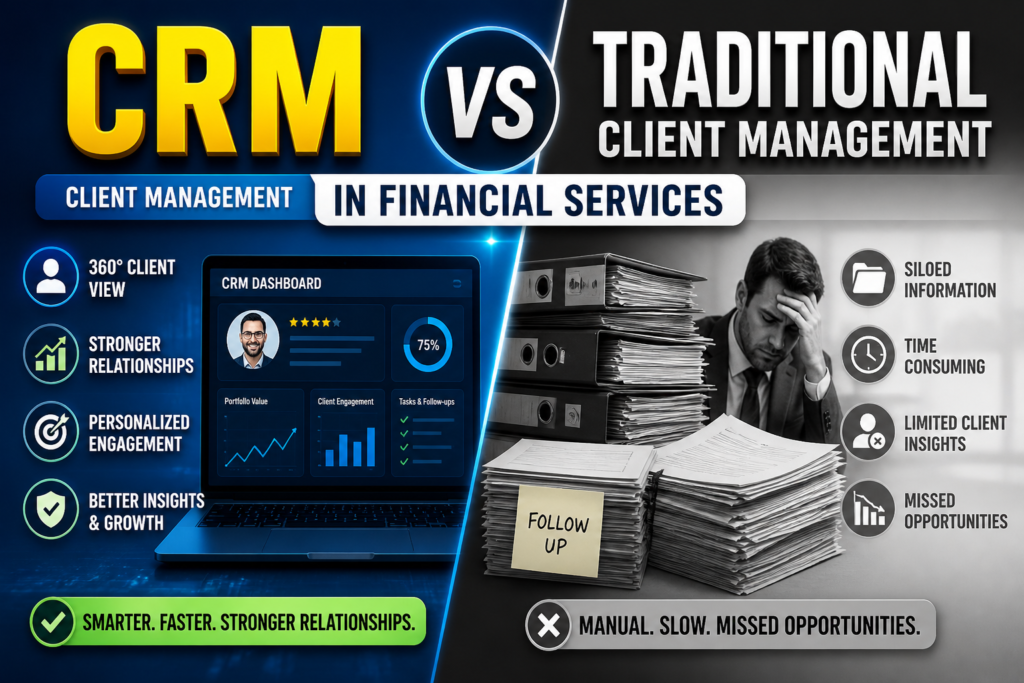
Financial services is built on trust, timing, and relationships. For decades, advisors, brokers, and wealth managers relied on spreadsheets, notebooks, emails, and memory to manage client interactions. That approach still exists, but it is rapidly being replaced by smarter systems. Today, CRM software is reshaping how financial professionals manage clients, track opportunities, and grow their business.
This article breaks down the real differences between CRM and traditional client management in financial services, and why the shift is happening faster than ever.
What Is Traditional Client Management?
Traditional client management refers to manual or semi-digital ways of handling client relationships. This includes:
- Excel sheets for tracking clients
- Email inboxes for communication
- Paper files or basic folders for documentation
- Calendar reminders for follow-ups
- Personal memory or notes for client preferences
This system worked in the past when client volumes were smaller and expectations were lower. But as financial services became more complex and competitive, cracks in this approach started to show.
What Is CRM in Financial Services?
A Customer Relationship Management system, or CRM, is a centralized platform designed to manage all client interactions and data in one place. In financial services, CRM tools are tailored to handle sensitive client data, compliance requirements, and relationship tracking.
Popular platforms like Salesforce CRM, HubSpot CRM, and Zoho CRM allow financial advisors to:
- Store and organize client information
- Track communication history
- Automate follow-ups
- Manage pipelines and opportunities
- Generate reports and insights
Instead of scattered data, everything is structured and accessible.
Key Differences Between CRM and Traditional Client Management
1. Data Organization
Traditional methods store data across multiple places. You might have client details in Excel, emails in Gmail, and notes in a diary. This creates fragmentation.
CRM systems centralize everything. Every client interaction, document, and update is stored in one unified system. This reduces errors and saves time.
2. Efficiency and Time Management
Manual processes take time. Updating spreadsheets, setting reminders, and searching for information slows down workflow.
CRM automates repetitive tasks. Follow-up emails, meeting reminders, and task assignments can run automatically. This frees up time for advisors to focus on actual client relationships.
3. Client Experience
With traditional systems, personalization depends on memory or manual notes. Important details can be missed.
CRM systems track every interaction. Advisors can see a full client history before every meeting. This leads to more personalized conversations and stronger relationships.
4. Scalability
Traditional client management struggles as your client base grows. More clients mean more spreadsheets, more emails, and more chances for mistakes.
CRM systems are built to scale. Whether you manage 50 clients or 5,000, the system remains organized and efficient.
5. Compliance and Security
Financial services operate under strict regulations. Managing compliance manually is risky.
CRM platforms often include compliance tracking, audit trails, and secure data storage. This reduces legal risks and ensures better documentation.
6. Reporting and Insights
Traditional methods offer limited insights. You need to manually analyze data to understand performance.
CRM systems provide real-time dashboards and analytics. You can track client engagement, revenue trends, and sales performance instantly.
Why Traditional Client Management Is Falling Behind
Traditional systems are not just outdated, they are limiting growth.
Here are the main issues:
- High risk of human error
- Lack of real-time visibility
- Poor coordination across teams
- Difficulty in tracking client journeys
- Time-consuming processes
In a competitive financial market, these limitations can directly impact revenue and client retention.
Advantages of CRM in Financial Services
Better Client Retention
CRM systems help maintain consistent communication. Automated reminders ensure no client is forgotten. This builds trust and long-term relationships.
Improved Productivity
Advisors spend less time on admin work and more time on strategy and client interaction.
Data-Driven Decisions
With detailed analytics, firms can make smarter decisions about investments, marketing, and client engagement.
Stronger Collaboration
Teams can access shared data, making collaboration easier. Everyone stays on the same page.
Automation
Routine tasks like follow-ups, onboarding emails, and reporting can be automated, reducing workload.
Real-World Example
Imagine a financial advisor managing 200 clients.
With traditional methods:
- Client data is spread across files and emails
- Follow-ups are missed
- Reporting takes hours
With CRM:
- All client data is in one place
- Automated reminders handle follow-ups
- Reports are generated instantly
The difference is not small, it directly impacts efficiency, revenue, and client satisfaction.
Challenges of CRM Adoption
CRM is powerful, but it is not perfect. Some firms hesitate to adopt it due to:
Initial Cost
CRM systems require investment. However, the long-term return usually outweighs the cost.
Learning Curve
Teams need time to learn and adapt. Proper training is essential.
Data Migration
Moving data from old systems to a CRM can be complex. It requires planning and accuracy.
How to Transition from Traditional to CRM
If you are still using traditional methods, the shift to CRM should be gradual and structured.
Step 1: Identify Your Needs
Understand what problems you want to solve. Is it client tracking, automation, or reporting?
Step 2: Choose the Right CRM
Select a platform that fits your business size and requirements.
Step 3: Clean Your Data
Before migrating, organize and clean your existing client data.
Step 4: Train Your Team
Ensure everyone understands how to use the CRM effectively.
Step 5: Start Small
Begin with basic features, then gradually use advanced tools.
CRM vs Traditional Client Management: Quick Comparison
| Feature | Traditional Management | CRM System |
|---|---|---|
| Data Storage | Scattered | Centralized |
| Automation | Minimal | High |
| Client Insights | Limited | Advanced |
| Scalability | Low | High |
| Compliance | Manual | Built-in tools |
| Efficiency | Time-consuming | Streamlined |
The Future of Client Management in Finance
The financial industry is moving toward digital transformation. CRM is no longer optional, it is becoming a necessity.
With the rise of AI, predictive analytics, and automation, CRM systems will become even more powerful. They will not just manage clients but also predict behavior, suggest actions, and improve decision-making.
Traditional methods simply cannot compete with this level of intelligence and efficiency.
Final Thoughts
CRM vs traditional client management in financial services is not just a comparison of tools, it is a comparison of approaches.
Traditional methods rely on manual effort and fragmented data. CRM systems offer automation, organization, and insights.
For financial advisors who want to grow, improve client relationships, and stay competitive, CRM is the clear choice.
The transition may take effort, but the long-term benefits are hard to ignore
