
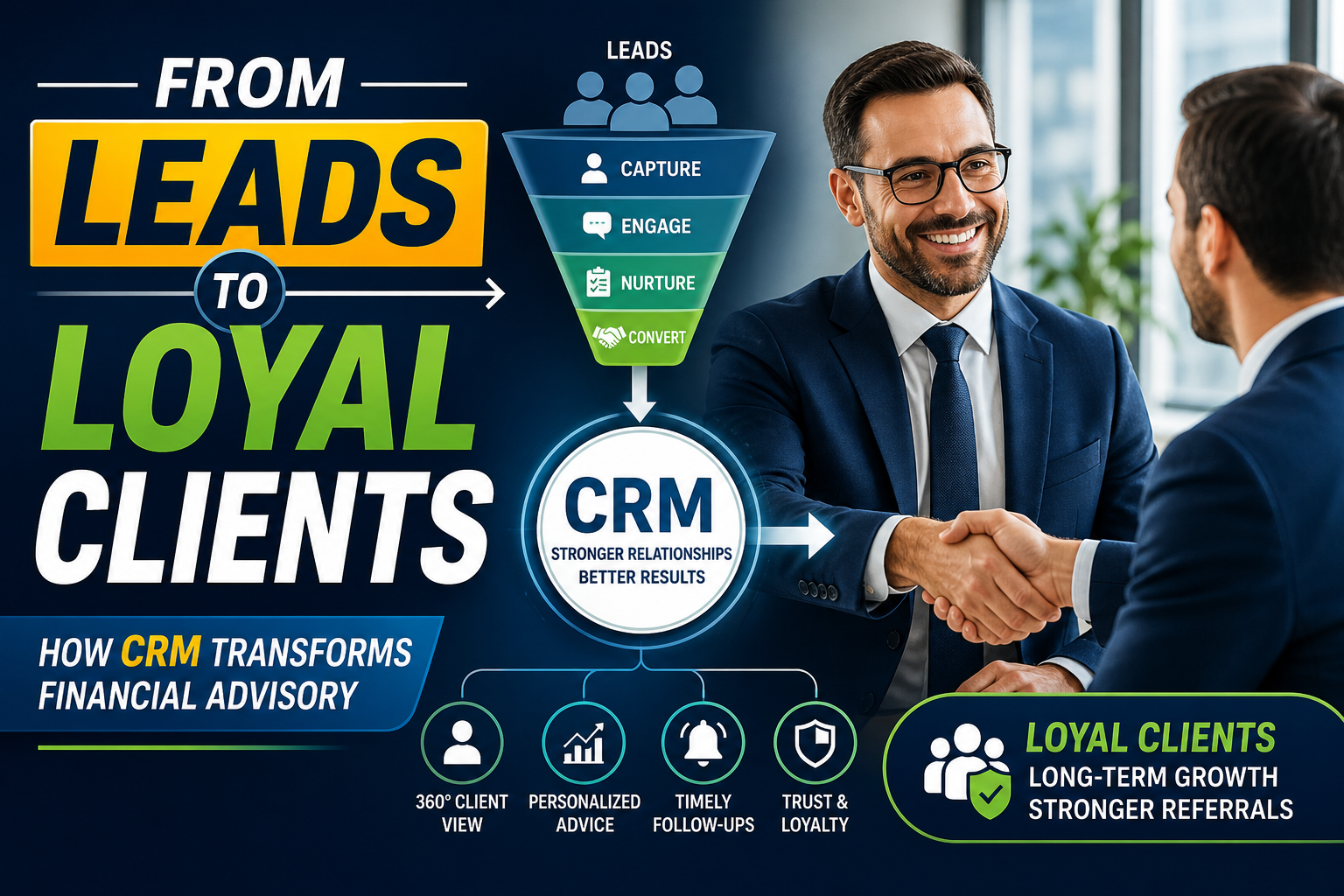
Turn prospects into long-term clients using CRM strategies designed for financial advisors. Improve tracking, engagement, and conversions.
In financial advisory, relationships are everything. You’re not just managing portfolios, you’re managing trust, expectations, and long-term goals. But as your client base grows, keeping track of every interaction, preference, and opportunity becomes harder. That’s where CRM for financial advisors starts to change the game.
A well-implemented CRM system doesn’t just organize your data. It reshapes how you attract leads, nurture them, and turn them into loyal, long-term clients. Let’s break down how that transformation actually happens in practice.
What CRM Means in Financial Advisory
CRM stands for Customer Relationship Management, but in financial services, it goes deeper than just storing contact details. A CRM for financial advisors acts as a centralized system where you manage client data, track interactions, automate follow-ups, and analyze behavior.
Instead of scattered spreadsheets, emails, and notes, everything lives in one place. That alone reduces friction. But the real value comes from how you use that data.
Stage 1: Capturing and Organizing Leads
Every advisory business depends on a steady flow of leads. These can come from referrals, digital marketing, social media, or events. The problem is not getting leads, it’s managing them properly.
Without a CRM, leads often slip through the cracks. Someone fills a form, you forget to follow up. Or you contact them once and never revisit.
A CRM for financial advisors fixes this by:
- Automatically capturing leads from websites and campaigns
- Storing detailed profiles including source, interests, and financial goals
- Assigning leads to advisors or teams
- Setting reminders for follow-ups
Instead of reacting randomly, you now have a structured pipeline. Every lead is visible, trackable, and actionable.
Stage 2: Lead Nurturing Becomes Systematic
Not every lead is ready to invest immediately. In fact, most aren’t. They need education, trust, and time.
This is where many advisors lose potential clients. Without consistent follow-up, leads go cold.
A CRM helps you build a nurturing system:
- Automated email sequences based on client interest
- Scheduled follow-ups so no lead is ignored
- Notes on previous conversations for personalized communication
- Segmentation based on age, income, goals, or risk appetite
For example, a young professional interested in SIPs should not receive the same communication as a retiree looking for wealth preservation. CRM makes that distinction easy.
Over time, this consistent engagement builds familiarity. And in finance, familiarity builds trust.
Stage 3: Personalization at Scale
Clients today expect personalized advice. Generic communication doesn’t work anymore.
The challenge is doing personalization without increasing workload.
With a CRM for financial advisors, personalization becomes scalable:
- Track client preferences, investment history, and life events
- Send tailored recommendations based on data
- Remember key details like birthdays, anniversaries, or milestones
- Customize communication tone and frequency
When a client feels like you truly understand their needs, they’re more likely to stay with you long-term.
And importantly, CRM ensures that this personalization is not dependent on memory. It’s built into your system.
Stage 4: Improving Client Onboarding
First impressions matter. A smooth onboarding process sets the tone for the entire relationship.
Without CRM, onboarding often involves manual paperwork, repeated data entry, and delays.
CRM systems streamline onboarding by:
- Digitizing forms and documentation
- Tracking onboarding progress in real time
- Automating verification steps
- Centralizing all client data from day one
This reduces friction for both the advisor and the client. A faster, more professional onboarding experience increases confidence and reduces drop-offs.
Stage 5: Enhancing Communication and Follow-Ups
Inconsistent communication is one of the biggest reasons clients disengage.
Clients don’t expect daily calls, but they do expect timely updates, especially during market volatility.
A CRM for financial advisors helps maintain consistent communication:
- Automated reminders for periodic reviews
- Alerts for important events like portfolio changes or market triggers
- Centralized communication history
- Integration with email and messaging tools
You always know when you last contacted a client, what was discussed, and what needs to happen next.
That level of clarity improves both responsiveness and professionalism.
Stage 6: Data-Driven Decision Making
Advisory decisions should not rely only on intuition. Data plays a critical role.
CRM systems provide insights such as:
- Which leads convert the most
- Which services generate the highest revenue
- Client retention rates
- Engagement levels across different segments
This allows you to refine your strategy.
For example:
- If referral leads convert better than digital leads, you can invest more in referral programs
- If certain clients are inactive, you can proactively re-engage them
Over time, these small optimizations significantly improve growth.
Stage 7: Strengthening Client Retention
Acquiring a new client is expensive. Retaining an existing one is far more cost-effective.
CRM plays a major role in retention by ensuring:
- Regular engagement
- Timely reviews and updates
- Personalized service
- Quick issue resolution
Clients leave when they feel ignored or undervalued. CRM minimizes that risk.
You can also identify warning signs early. For instance, if a client hasn’t interacted in months, your CRM can flag them for follow-up.
That proactive approach keeps relationships alive.
Stage 8: Automating Repetitive Tasks
A lot of an advisor’s time goes into administrative work rather than actual advising.
Tasks like:
- Scheduling meetings
- Sending reminders
- Updating records
- Preparing reports
These are necessary but time-consuming.
CRM automation reduces this burden:
- Auto-scheduling tools
- Pre-built email templates
- Workflow automation
- Report generation
This frees up your time to focus on what actually matters: advising clients and building relationships.
Stage 9: Building Long-Term Loyalty
Turning a client into a loyal advocate doesn’t happen overnight. It’s the result of consistent, high-quality experience.
CRM supports loyalty by ensuring:
- Consistency in service
- Transparency in communication
- Timely engagement
- Personalized interactions
When clients feel taken care of, they stay longer and refer others.
And referrals are often the highest-quality leads in financial advisory.
Key Benefits of CRM for Financial Advisors
Let’s summarize the transformation:
Before CRM:
- Disorganized data
- Missed follow-ups
- Generic communication
- Limited insights
- Reactive approach
After CRM:
- Centralized client information
- Structured lead management
- Personalized engagement
- Data-driven decisions
- Proactive relationship management
The shift is not just operational. It’s strategic.
Choosing the Right CRM for Your Practice
Not all CRM systems are built the same. When selecting a CRM for financial advisors, focus on:
- Ease of use
- Customization for financial workflows
- Integration with existing tools
- Data security and compliance
- Automation capabilities
Avoid overly complex systems that slow you down. The goal is efficiency, not added complexity.
