
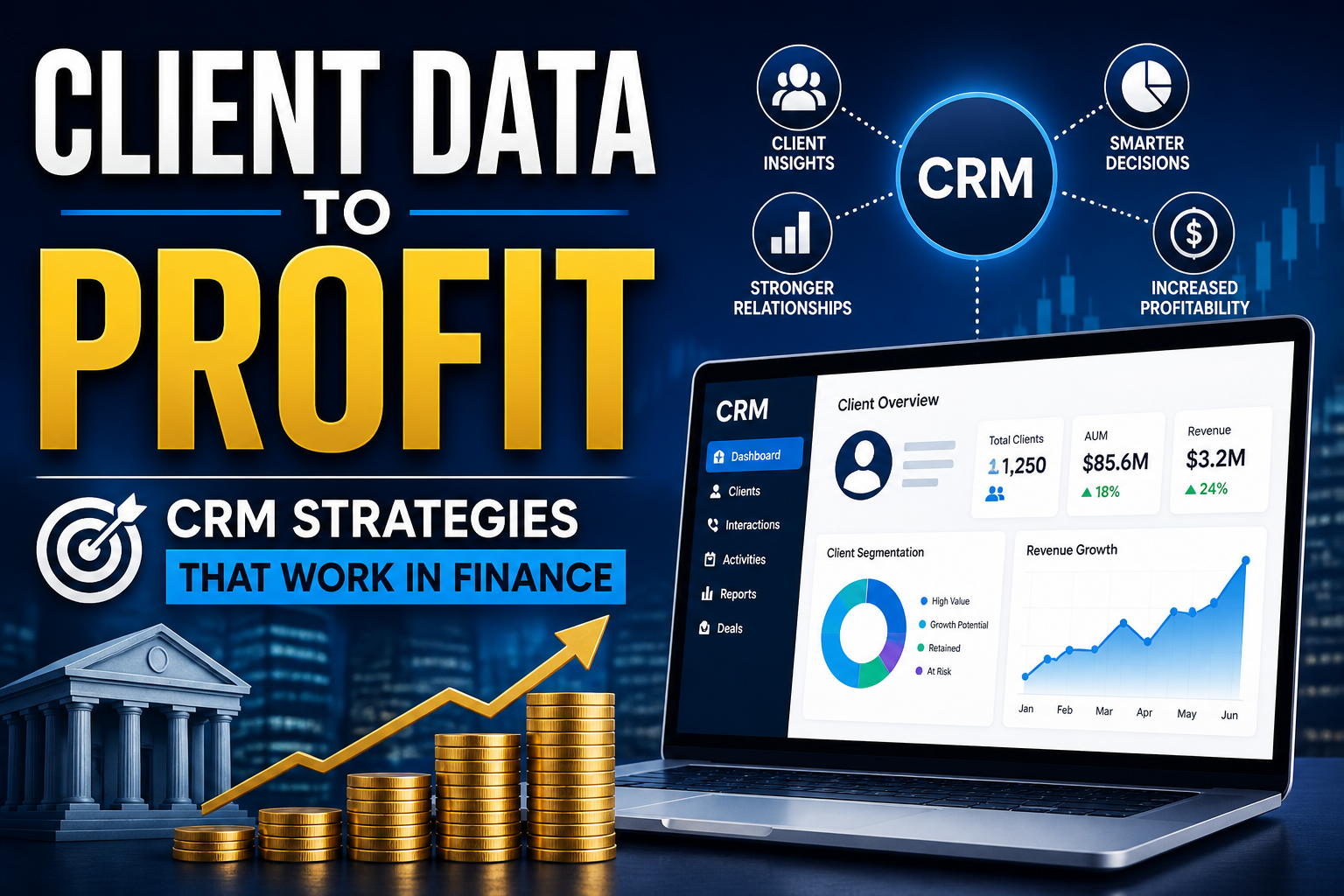
Learn how to turn client data into actionable insights using CRM tools to boost revenue and improve decision-making in finance.
In financial services, data is everywhere. Every transaction, interaction, and inquiry leaves a trail. The real advantage, however, is not in collecting data but in using it effectively. This is where CRM (Customer Relationship Management) systems step in. When used strategically, CRM transforms raw client data into measurable profit.
This blog breaks down how financial institutions can use CRM to drive revenue, improve customer retention, and make smarter decisions.
Why CRM Matters in Financial Services
Banks, insurance firms, wealth managers, and fintech companies deal with highly sensitive and complex customer relationships. Unlike retail or eCommerce, financial decisions are long-term, trust-driven, and data-heavy.
CRM systems help centralize this data and turn it into actionable insights.
Instead of scattered spreadsheets or disconnected tools, CRM gives you:
- A single view of each client
- Real-time insights into behavior and preferences
- Better coordination across teams
- Data-driven decision-making
The result is not just operational efficiency, but stronger customer relationships that directly impact revenue.
Understanding Client Data in Finance
Before applying strategies, it is important to understand what “client data” actually includes in finance.
Types of Client Data:
- Demographic data: Age, income, occupation
- Behavioral data: Transaction patterns, product usage
- Interaction data: Emails, calls, meetings
- Financial data: Investments, loans, credit scores
- Lifecycle data: Onboarding stage, retention risk, churn signals
A CRM system aggregates all of this into a unified profile. That profile becomes the foundation for every strategy.
Strategy 1: Segmentation That Drives Precision
Not all clients are the same. Treating them equally often leads to missed opportunities.
CRM allows you to segment clients based on meaningful criteria such as:
- Net worth
- Risk appetite
- Investment behavior
- Product usage
Example:
A wealth management firm can segment clients into:
- High-net-worth individuals (HNWIs)
- Emerging investors
- Retirement-focused clients
Each segment gets tailored communication, offers, and services.
Impact on profit:
- Higher conversion rates
- Better targeting of premium products
- Reduced marketing waste
Strategy 2: Personalized Financial Recommendations
Generic offers do not work in finance. Clients expect advice that fits their specific goals.
CRM systems analyze past behavior and financial data to recommend:
- Investment products
- Insurance plans
- Loan offers
- Savings strategies
Example:
If a client shows consistent surplus income and low-risk tolerance, CRM can trigger a recommendation for fixed-income instruments or conservative mutual funds.
Impact on profit:
- Increased cross-selling
- Higher client satisfaction
- Stronger long-term relationships
Strategy 3: Automating Client Journeys
Financial services often involve long customer journeys. From onboarding to investment maturity, there are multiple touchpoints.
CRM automation ensures that no opportunity is missed.
Key Automation Areas:
- Onboarding workflows
- KYC reminders
- Investment maturity alerts
- Renewal notifications
- Follow-ups after consultations
Example:
When a fixed deposit is about to mature, the CRM can automatically notify both the client and the relationship manager, suggesting reinvestment options.
Impact on profit:
- Reduced churn
- Increased renewals
- Consistent engagement
Strategy 4: Improving Cross-Selling and Upselling
One of the biggest revenue drivers in finance is selling more to existing clients.
CRM identifies cross-selling opportunities by analyzing:
- Current product portfolio
- Financial goals
- Life events (marriage, retirement, etc.)
Example:
A client with a home loan may be a strong candidate for:
- Home insurance
- Tax-saving investment plans
CRM can flag this opportunity and suggest the right timing for outreach.
Impact on profit:
- Higher customer lifetime value (CLV)
- Lower acquisition costs
- Better product penetration
Strategy 5: Predictive Analytics for Smarter Decisions
Modern CRM systems use predictive analytics to forecast behavior.
This includes:
- Churn prediction
- Investment trends
- Credit risk assessment
- Sales forecasting
Example:
If CRM detects reduced engagement and declining account activity, it can flag the client as “at risk” and trigger retention efforts.
Impact on profit:
- Proactive retention
- Reduced default risk
- Better planning and forecasting
Strategy 6: Enhancing Customer Experience
In finance, trust is everything. A smooth, responsive experience builds that trust.
CRM improves customer experience by:
- Providing a 360-degree client view
- Enabling faster query resolution
- Maintaining interaction history
- Ensuring consistent communication
Example:
When a client calls support, the agent can instantly see:
- Past transactions
- Previous issues
- Current products
This eliminates repetition and improves satisfaction.
Impact on profit:
- Higher retention rates
- Increased referrals
- Strong brand loyalty
Strategy 7: Compliance and Data Security Management
Financial institutions operate under strict regulatory frameworks. CRM helps ensure compliance by:
- Tracking consent and communication preferences
- Maintaining audit trails
- Securing sensitive data
- Automating compliance reporting
Example:
CRM can log all client communications, making it easier to meet regulatory requirements during audits.
Impact on profit:
- Reduced legal risks
- Avoidance of penalties
- Improved operational reliability
Strategy 8: Sales Team Productivity
CRM is not just for data storage. It is a powerful tool for improving team performance.
Features That Boost Productivity:
- Lead management dashboards
- Task automation
- Pipeline tracking
- Performance analytics
Example:
A sales manager can track which leads are converting and which are stuck, allowing quick intervention.
Impact on profit:
- Faster deal closures
- Better resource allocation
- Increased revenue per employee
Strategy 9: Omnichannel Communication
Today’s clients interact across multiple channels:
- Phone
- Mobile apps
- Social media
CRM integrates these channels into a single system.
Example:
A client may start an inquiry via email and complete it via a phone call. CRM ensures continuity without losing context.
Impact on profit:
- Improved engagement
- Higher satisfaction
- Increased conversion rates
Strategy 10: Data-Driven Decision Making
The biggest advantage of CRM is the ability to make decisions based on real data rather than assumptions.
CRM dashboards provide insights such as:
- Revenue trends
- Customer acquisition cost
- Product performance
- Client retention rates
Example:
If a particular investment product shows high adoption among young professionals, the firm can increase marketing efforts in that segment.
Impact on profit:
- Better strategic planning
- Optimized marketing spend
- Higher ROI
Challenges in CRM Adoption (and How to Solve Them)
While CRM offers clear benefits, implementation is not always straightforward.
Common Challenges:
- Data silos
- Resistance from staff
- Poor data quality
- Lack of training
Solutions:
- Integrate all systems into a unified platform
- Train teams regularly
- Clean and standardize data
- Set clear KPIs for CRM usage
A well-implemented CRM strategy requires both technology and organizational alignment.
Future of CRM in Financial Services
CRM is evolving rapidly with technologies like:
- Artificial Intelligence (AI)
- Machine Learning (ML)
- Real-time analytics
These advancements will make CRM even more predictive and proactive.
What to Expect:
- Hyper-personalized financial advice
- AI-driven chat and support
- Real-time fraud detection
- Automated investment insights
Financial institutions that adopt these innovations early will gain a significant competitive edge.
Conclusion
Client data is one of the most valuable assets in financial services. But data alone does not create profit. The real value comes from how effectively that data is used.
CRM systems bridge this gap by turning information into actionable insights. From segmentation and personalization to automation and predictive analytics, CRM strategies help financial institutions:
- Increase revenue
- Improve customer retention
- Enhance operational efficiency
In a competitive market where trust and precision matter, CRM is no longer optional. It is a core driver of growth.
If used correctly, CRM does not just manage relationships. It builds them and turns them into long-term profitability.
