
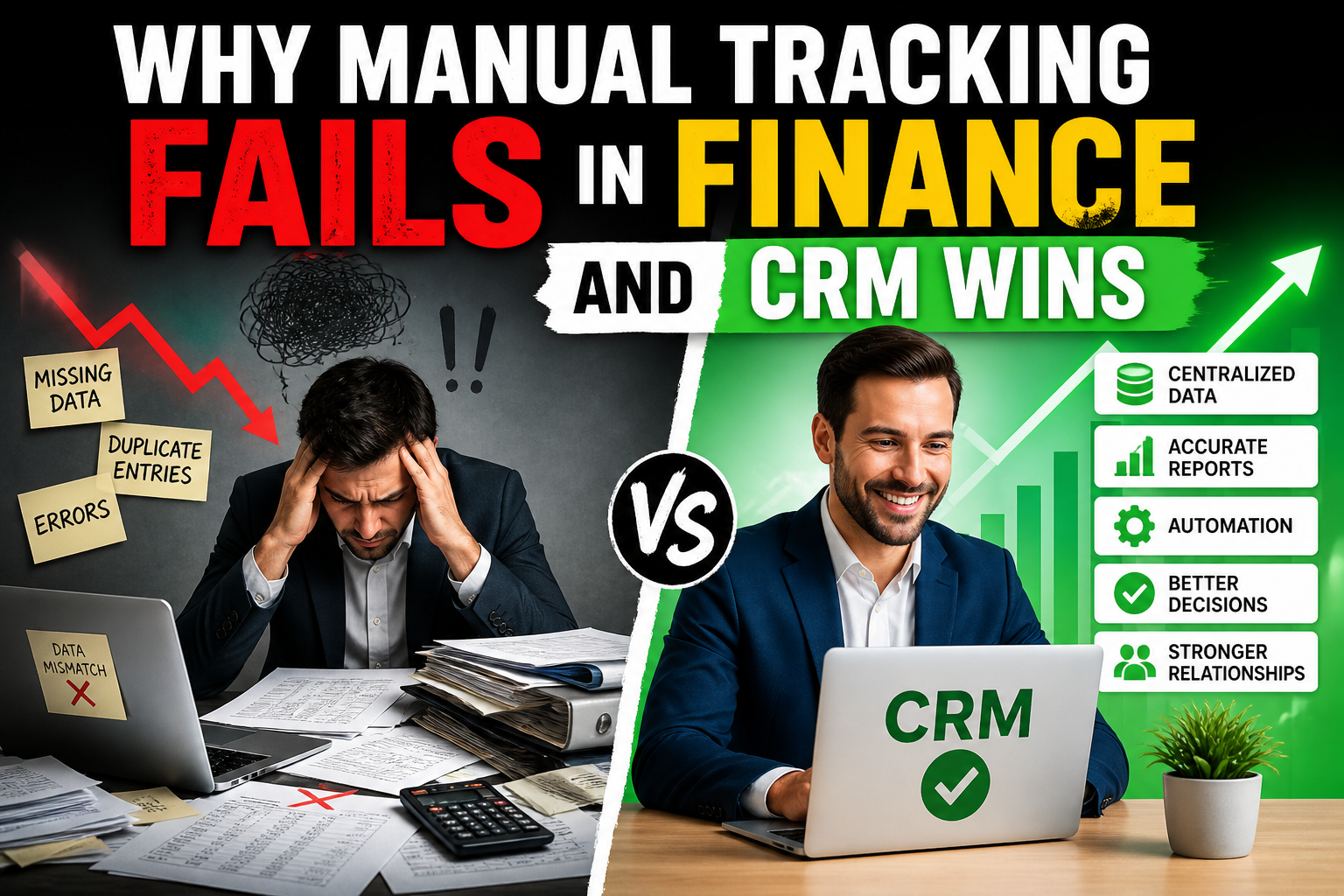
Explore why spreadsheets and manual tracking limit growth, and how CRM systems provide accuracy, scalability, and better client management.
In finance, precision is everything. Whether you’re managing leads for a lending business, tracking client portfolios, or handling compliance workflows, small errors can turn into serious financial risks. Yet many organizations still rely on manual tracking systems like spreadsheets, email threads, and disconnected tools. It might work at a small scale, but as operations grow, manual tracking quickly becomes a liability.
This is where CRM (Customer Relationship Management) systems step in. A well-implemented CRM doesn’t just organize data. It transforms how financial institutions operate, make decisions, and serve customers.
Let’s break down why manual tracking fails and how CRM systems consistently outperform it.
The Reality of Manual Tracking in Finance
Manual tracking often starts as a quick and inexpensive solution. Teams use Excel sheets, shared drives, or even handwritten notes to manage data. Initially, it feels flexible and easy to control.
But finance is not a static environment. As customer volumes grow, compliance requirements tighten, and workflows become more complex, manual systems start to crack.
Here are the core problems.
1. High Risk of Human Error
Manual data entry is inherently error-prone. A misplaced decimal, incorrect entry, or duplicate record can have serious consequences in financial operations.
In areas like:
- Loan processing
- Investment tracking
- Payment reconciliation
even a minor mistake can lead to financial loss or compliance issues.
CRM systems reduce this risk by:
- Automating data capture
- Validating inputs
- Eliminating duplicate entries
Instead of relying on memory or manual updates, the system ensures accuracy at every step.
2. Lack of Real-Time Data Visibility
Manual tracking systems don’t provide real-time insights. Data is often outdated because it depends on when someone last updated the file.
This creates problems like:
- Inconsistent reporting
- Delayed decision-making
- Misalignment between teams
In finance, timing matters. A delayed update can mean missed opportunities or poor risk assessment.
CRM platforms solve this by:
- Centralizing all data
- Updating records in real time
- Providing dashboards and live reports
Decision-makers always have access to the latest information.
3. Poor Collaboration Across Teams
Finance teams often include multiple departments such as sales, underwriting, compliance, and customer service. Manual tracking makes collaboration difficult because information is scattered.
Common issues include:
- Multiple versions of the same file
- Email chains with outdated data
- Lack of accountability
CRM systems bring everyone onto a single platform. Every interaction, update, and note is recorded in one place.
This leads to:
- Better coordination
- Clear ownership of tasks
- Faster workflow execution
4. Inefficient Workflow Management
Manual systems require constant follow-ups. Tasks are tracked through emails, reminders, or personal notes.
This leads to:
- Missed deadlines
- Forgotten follow-ups
- Inconsistent customer experience
CRM platforms automate workflows. For example:
- Lead assignment happens automatically
- Follow-up reminders are system-generated
- Approval processes are streamlined
This not only improves efficiency but also ensures nothing falls through the cracks.
5. Limited Scalability
Manual tracking might work for 50 clients, but what about 5,000?
As financial businesses grow, data volume increases exponentially. Managing this manually becomes chaotic.
Challenges include:
- Slower processing times
- Increased errors
- Difficulty maintaining records
CRM systems are designed to scale. Whether you handle hundreds or millions of records, the system maintains performance and structure.
6. Compliance and Audit Challenges
The finance industry operates under strict regulatory frameworks. Maintaining proper records is not optional.
Manual systems make compliance difficult because:
- Data is not consistently recorded
- Audit trails are incomplete
- Document retrieval is slow
CRM platforms provide:
- Automated record-keeping
- Complete audit trails
- Secure data storage
This makes regulatory compliance much easier and reduces the risk of penalties.
7. Lack of Customer Insights
Manual tracking focuses on storing data, not analyzing it. As a result, businesses miss valuable insights about customer behavior.
Without proper insights, you cannot:
- Personalize services
- Identify high-value clients
- Predict future needs
CRM systems use data analytics to provide:
- Customer segmentation
- Behavioral insights
- Predictive analysis
This allows financial institutions to offer tailored services and improve customer satisfaction.
Why CRM Wins in Finance
CRM is not just a tool. It’s a strategic system that connects people, processes, and data.
Here’s how CRM creates a competitive advantage.
Centralized Data Management
All customer information is stored in one place. This includes:
- Contact details
- Transaction history
- Communication records
No more switching between tools or searching through emails. Everything is accessible instantly.
Automation of Repetitive Tasks
CRM eliminates repetitive manual work such as:
- Data entry
- Follow-up scheduling
- Status updates
This allows teams to focus on high-value activities like relationship building and strategic planning.
Enhanced Customer Experience
Customers expect fast and personalized service. CRM systems make this possible by providing a complete view of each customer.
This leads to:
- Faster response times
- Personalized communication
- Better relationship management
Data-Driven Decision Making
With CRM analytics, financial institutions can:
- Track performance metrics
- Identify trends
- Forecast revenue
Instead of guessing, decisions are based on real data.
Improved Sales and Lead Management
CRM systems streamline the entire sales funnel:
- Lead capture
- Qualification
- Conversion
Sales teams can prioritize the right opportunities and close deals faster.
Better Risk Management
In finance, risk assessment is critical. CRM systems help by:
- Tracking customer behavior
- Monitoring financial activities
- Identifying red flags early
This reduces exposure to risk and improves overall stability.
Real-World Example
Consider a lending company managing loan applications manually. Each application is tracked in spreadsheets, documents are stored in folders, and communication happens through emails.
Problems arise quickly:
- Missing documents
- Delayed approvals
- Poor customer communication
Now imagine the same process with a CRM:
- Applications are tracked automatically
- Documents are stored securely in one place
- Status updates are visible in real time
- Customers receive automated notifications
The difference is not just efficiency. It’s reliability and scalability.
Transitioning from Manual to CRM
Switching to a CRM system requires planning, but the benefits outweigh the effort.
Key steps include:
- Identifying current workflow gaps
- Choosing the right CRM platform
- Migrating existing data carefully
- Training your team
- Continuously optimizing processes
The goal is not just to replace manual tracking, but to improve the entire operational structure.
Common Misconceptions About CRM
Some businesses hesitate to adopt CRM due to misconceptions.
“CRM is expensive”
In reality, the cost of errors and inefficiencies in manual systems is much higher.
“It’s too complex”
Modern CRM platforms are user-friendly and customizable.
“We don’t need it yet”
If you’re already facing data or workflow issues, the need is already there.
The Future of Finance is Automated
The financial industry is moving toward automation, data intelligence, and customer-centric operations. Manual tracking simply cannot keep up with this shift.
CRM systems are becoming the backbone of modern financial services by:
- Integrating with other tools
- Leveraging AI for insights
- Enhancing operational efficiency
Businesses that adopt CRM early gain a strong competitive advantage.
Conclusion
Manual tracking in finance is no longer sustainable. It introduces errors, limits visibility, slows down operations, and creates compliance risks.
CRM systems solve these challenges by centralizing data, automating workflows, and providing actionable insights. They don’t just improve efficiency. They transform how financial institutions operate and grow.
If your business is still relying on spreadsheets and manual processes, it’s not just an operational issue. It’s a strategic risk.
Adopting a CRM is not about keeping up. It’s about staying ahead.
