
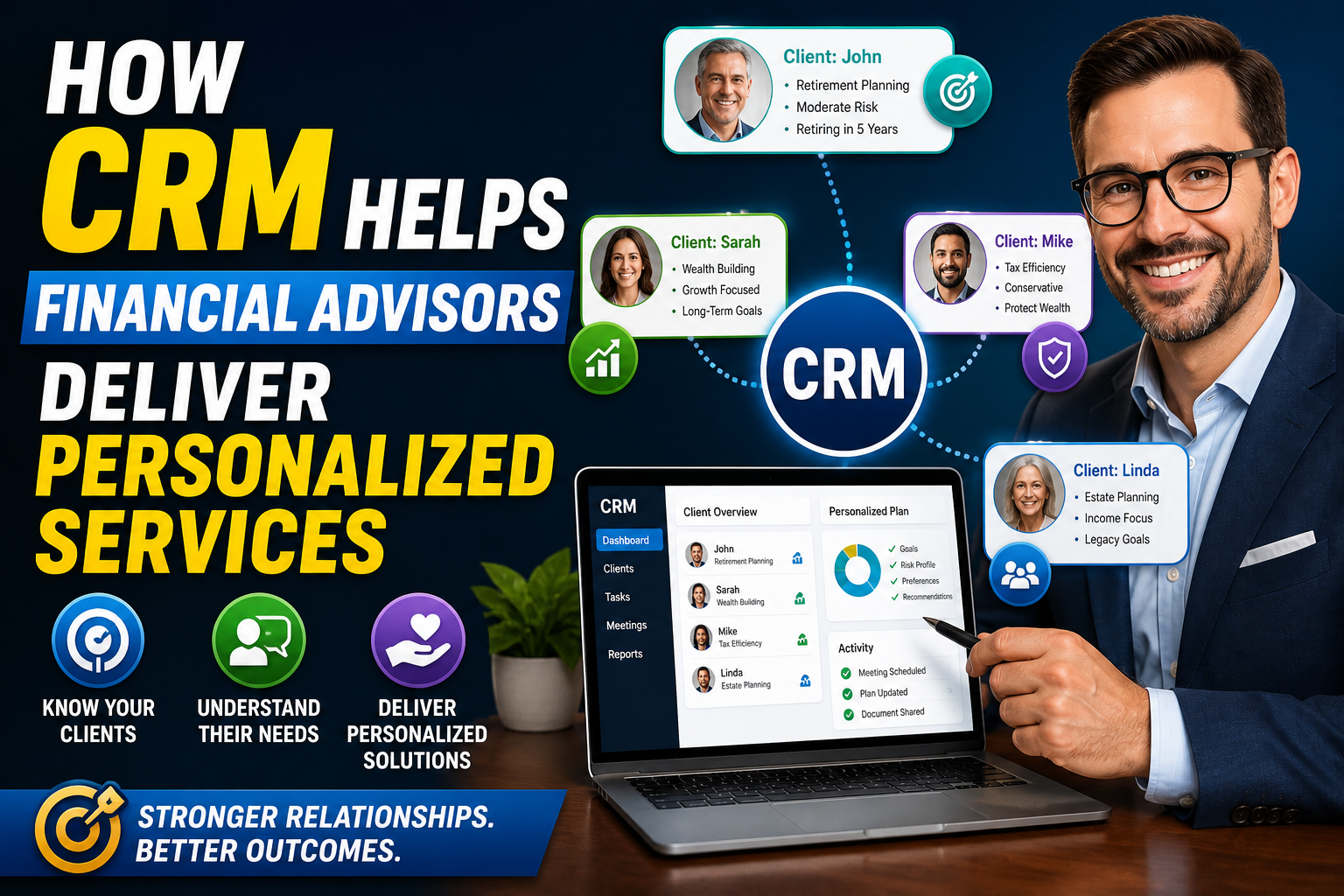
See how CRM systems enable personalized financial advice, improving client satisfaction and long-term loyalty.
In financial advisory, trust is everything. Clients are not just looking for someone to manage their money, they want guidance tailored to their goals, risk tolerance, and life stage. That level of personalization is difficult to deliver consistently if you are relying on spreadsheets, scattered notes, or memory.
This is where a CRM (Customer Relationship Management) system becomes essential. Tools like Salesforce, HubSpot, and Zoho CRM help financial advisors move from reactive service to proactive, highly personalized client engagement.
Let’s break down how CRM systems enable financial advisors to deliver better, more personalized services at scale.
1. Centralized Client Data for a 360° View
One of the biggest challenges advisors face is fragmented data. Client information often lives across emails, spreadsheets, meeting notes, and financial tools. This makes it hard to get a complete picture.
A CRM solves this by centralizing everything in one place:
- Personal details (age, family, occupation)
- Financial data (assets, liabilities, investments)
- Communication history (calls, emails, meetings)
- Preferences and risk profiles
With this unified view, advisors can instantly understand a client’s full financial situation. This allows for more relevant conversations instead of generic advice.
For example, instead of asking basic questions repeatedly, you can pick up exactly where the last conversation ended. That continuity builds trust and shows professionalism.
2. Deeper Client Segmentation
Not all clients are the same. A young professional investing for the first time has very different needs compared to a retiree managing wealth preservation.
CRM systems allow you to segment clients based on:
- Income level
- Investment goals
- Risk tolerance
- Life stage
- Behavior patterns
Once segmented, you can tailor your communication and services accordingly.
For instance:
- High-net-worth clients may receive detailed portfolio reviews
- New investors may get educational content and guidance
- Retirees may receive income-focused planning strategies
This level of segmentation ensures every client feels understood rather than treated as just another account.
3. Personalized Communication at Scale
Manually customizing communication for every client is not realistic as your client base grows. CRM platforms solve this through automation without losing the personal touch.
You can:
- Send personalized emails using client data
- Set reminders for birthdays, anniversaries, or milestones
- Automate follow-ups after meetings
- Share relevant market insights based on client interests
For example, if a client is interested in mutual funds, your CRM can automatically send curated updates related to that topic.
This keeps communication relevant and timely, which strengthens long-term relationships.
4. Tracking Client Interactions and Preferences
Every interaction with a client matters. A CRM records every touchpoint:
- Phone calls
- Emails
- Meeting notes
- Document sharing
Over time, this builds a detailed interaction history. Advisors can see what was discussed, what concerns were raised, and what actions were promised.
This helps in two ways:
- Consistency – You never miss important details
- Relevance – Future conversations are more meaningful
For example, if a client previously showed concern about market volatility, you can proactively address it in your next discussion instead of waiting for them to bring it up again.
5. Proactive Financial Planning
Traditional advisory models are often reactive. Clients reach out when they need something. But modern clients expect proactive service.
CRM systems enable proactive engagement by:
- Setting alerts for key financial events
- Tracking portfolio changes
- Notifying advisors about client milestones
For example:
- When a client is nearing retirement age
- When market conditions affect their portfolio
- When a policy renewal is due
Instead of waiting, you reach out with timely advice. This positions you as a strategic partner rather than just a service provider.
6. Workflow Automation for Efficiency
Personalization is not just about communication, it is also about speed and consistency. CRM tools automate repetitive tasks so advisors can focus on high-value interactions.
Common automations include:
- Onboarding workflows
- Document collection reminders
- Compliance tracking
- Meeting scheduling
By reducing manual work, advisors have more time to understand clients deeply and provide tailored advice.
Efficiency directly translates into better service quality.
7. Better Collaboration Within Teams
In larger advisory firms, multiple team members may interact with the same client. Without a CRM, this can lead to miscommunication or duplication of effort.
CRM systems ensure everyone is aligned:
- Shared client profiles
- Internal notes and updates
- Task assignments
- Communication logs
This means any team member can step in and still deliver a consistent, personalized experience.
Clients do not need to repeat themselves, which improves satisfaction significantly.
8. Data-Driven Insights for Personalization
CRM platforms are not just storage tools, they also provide analytics.
You can track:
- Client engagement levels
- Product performance
- Communication effectiveness
- Client retention trends
These insights help you refine your approach.
For example:
- Identify which clients need more attention
- Understand what services are most valuable
- Optimize communication strategies
This data-driven approach makes personalization more precise and effective.
9. Compliance and Documentation Made Easy
Financial advisory is a highly regulated field. Keeping accurate records is not optional, it is mandatory.
CRM systems help by:
- Storing all communication records
- Tracking client approvals
- Maintaining audit trails
- Managing compliance workflows
This not only reduces risk but also ensures transparency with clients.
When clients see organized, well-documented processes, it increases confidence in your services.
10. Enhancing Client Experience and Retention
At the end of the day, personalization leads to better client experience. And better experience leads to higher retention.
Clients are more likely to stay with advisors who:
- Understand their goals
- Communicate proactively
- Provide relevant advice
- Respond quickly
CRM systems make all of this possible at scale.
Satisfied clients also become a source of referrals, which is crucial for growth in financial advisory businesses.
Practical Example: Before vs After CRM
Without CRM:
- Scattered client data
- Missed follow-ups
- Generic communication
- Reactive service
With CRM:
- Centralized information
- Timely reminders
- Personalized communication
- Proactive financial planning
The difference is clear. CRM transforms how advisors operate and how clients perceive their value.
Choosing the Right CRM for Financial Advisors
Not all CRM tools are built the same. Financial advisors should look for:
- Custom fields for financial data
- Integration with financial tools
- Strong security features
- Automation capabilities
- Reporting and analytics
Platforms like Salesforce Financial Services Cloud are specifically designed for financial professionals, while tools like Zoho CRM and HubSpot offer flexibility and affordability.c
The right choice depends on your business size, budget, and complexity.
