
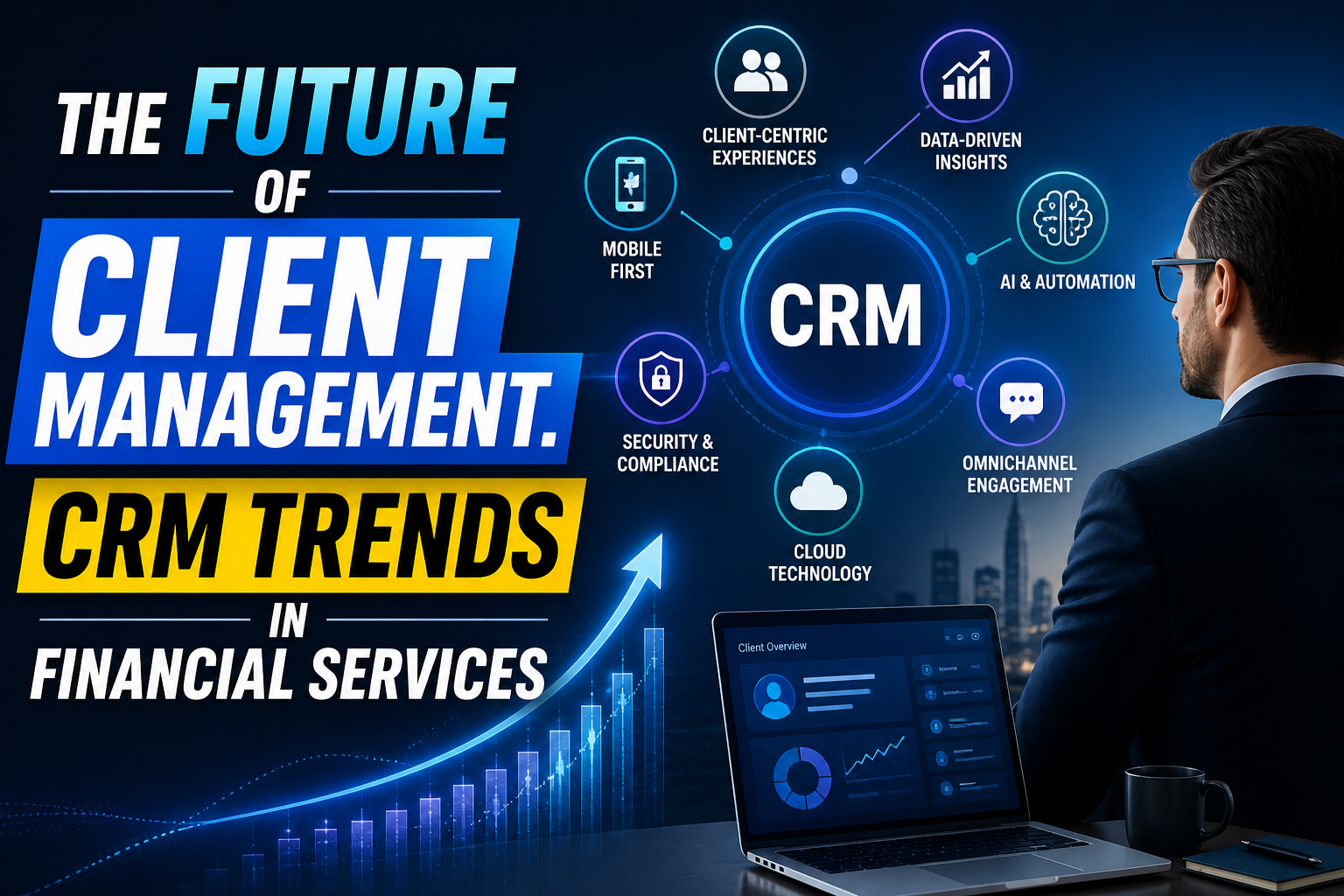
Stay ahead with the latest CRM trends shaping financial services, including AI, automation, and data-driven client engagement.
The financial services industry is going through a structural shift in how it manages client relationships. Traditional CRM systems that once acted as simple databases are evolving into intelligent, predictive, and highly automated platforms. Today, client management is no longer just about storing contact details or tracking interactions. It is about delivering personalized, proactive, and seamless experiences across every touchpoint.
In this blog, we will break down the key CRM trends shaping the future of client management in financial services and what they mean for banks, wealth managers, insurance firms, and fintech companies.
Introduction: Why CRM Matters More Than Ever
Customer expectations in finance have changed dramatically. Clients now expect the same level of personalization and convenience they get from digital platforms like e-commerce or streaming services. At the same time, financial institutions are under pressure to improve efficiency, ensure compliance, and stay competitive.
This is where modern CRM systems come in.
A CRM in financial services helps institutions centralize customer data, automate workflows, and deliver personalized experiences at scale.
It acts as the backbone for client engagement, sales, and service operations.
As technology evolves, CRM is becoming the core driver of customer experience and business growth.
1. AI-Powered CRM is Becoming the Standard
Artificial intelligence is no longer optional in CRM. It is becoming the foundation.
Modern CRM platforms are integrating AI to automate tasks, analyze customer data, and recommend next actions. In fact, AI is expected to handle up to 95% of customer interactions in banking environments.
What this means:
- Automated responses through chatbots and virtual assistants
- Smart lead scoring and prioritization
- AI-generated insights and recommendations
- Automated workflows for routine tasks
AI is also evolving beyond simple automation. New “agentic AI” systems can perform tasks independently, such as summarizing client meetings, generating reports, or even suggesting investment strategies.
Real-world momentum is already visible. Financial institutions are rapidly adopting AI agents to handle complex tasks like credit analysis and financial reporting.
Bottom line: CRM is shifting from a passive system to an active decision-making assistant.
2. Hyper-Personalization Will Define Client Experience
Generic communication is no longer acceptable in financial services.
Modern CRM systems use data analytics and AI to deliver hyper-personalized experiences based on:
- Spending behavior
- Investment patterns
- Risk appetite
- Life events
This allows institutions to offer tailored financial advice, targeted product recommendations, and proactive support.
Research shows that AI-driven personalization improves customer satisfaction, loyalty, and lifetime value.
Example use cases:
- Personalized loan or investment offers
- Real-time financial advice
- Automated portfolio recommendations
- Targeted cross-selling opportunities
Hyper-personalization also enables financial firms to identify the right moment to engage customers, increasing conversion rates and customer retention.
Bottom line: The future of CRM is not just knowing your customer but anticipating their needs.
3. Omnichannel Engagement is Now Essential
Customers interact with financial institutions through multiple channels:
- Mobile apps
- Websites
- Branch visits
- Social media
- Messaging platforms
Modern CRM systems unify all these touchpoints into a single platform.
This ensures that every interaction is:
- Consistent
- Context-aware
- Seamless
CRM platforms now integrate chat, voice, email, and social media into one system, allowing teams to manage all conversations in one place.
Why this matters:
- Customers don’t need to repeat information
- Advisors get a complete view of the client
- Service becomes faster and more efficient
Bottom line: Omnichannel CRM ensures a smooth and unified customer journey.
4. Predictive Analytics and Proactive Service
One of the biggest shifts in CRM is moving from reactive to proactive service.
Instead of waiting for customers to reach out, CRM systems now use predictive analytics to:
- Identify potential issues
- Forecast customer behavior
- Suggest next best actions
For example:
- Detecting when a customer might churn
- Identifying opportunities for upselling
- Predicting financial needs based on behavior
Predictive analytics allows financial institutions to solve problems before they happen and deliver a better customer experience.
Bottom line: The future of client management is proactive, not reactive.
5. Data Integration and 360-Degree Customer View
Data is the foundation of effective CRM.
Modern systems integrate data from multiple sources:
- Core banking systems
- Payment platforms
- Investment tools
- Third-party fintech apps
APIs play a critical role in enabling this integration, allowing systems to communicate seamlessly and share data in real time.
Benefits:
- Complete view of customer interactions
- Better decision-making
- Improved customer service
- More accurate risk assessment
A 360-degree customer view allows financial advisors to understand clients deeply and offer more relevant solutions.
Bottom line: Unified data is the backbone of modern CRM.
6. Automation is Driving Efficiency and Cost Reduction
Automation is transforming how financial institutions operate.
CRM systems now automate:
- Data entry
- Follow-ups
- Reporting
- Compliance tracking
- Marketing campaigns
This reduces manual work and improves efficiency.
AI and automation can significantly improve operational performance and reduce costs in banking.
Impact:
- Faster response times
- Reduced human error
- Lower operational costs
- Increased productivity
Bottom line: Automation allows teams to focus on high-value tasks instead of repetitive work.
7. CRM + Compliance and Data Security
In financial services, compliance is critical.
Modern CRM systems are designed to:
- Track customer interactions
- Maintain audit trails
- Ensure regulatory compliance
- Protect sensitive data
With increasing data usage, security and privacy have become top priorities.
CRM platforms help institutions meet regulatory requirements while still delivering personalized experiences.
Bottom line: CRM is not just about growth. It is also about governance and risk management.
8. Integration with Fintech Ecosystems
The rise of fintech is reshaping the financial landscape.
Modern CRM systems are no longer standalone tools. They are part of a larger ecosystem that includes:
- Payment gateways
- Investment platforms
- Lending apps
- Insurtech solutions
This integration allows financial institutions to:
- Offer more services
- Innovate faster
- Improve customer experience
Bottom line: CRM is becoming a central hub in a connected financial ecosystem.
9. Human + AI Collaboration
Despite the rise of AI, human interaction remains important in financial services.
The future is not AI replacing humans, but AI enhancing human capabilities.
How this works:
- AI handles routine tasks
- Advisors focus on complex decisions
- CRM provides insights and recommendations
This combination improves both efficiency and customer experience.
Even industry leaders emphasize that AI is meant to improve outcomes, not replace professionals.
Bottom line: The best client management strategies combine technology with human expertise.
Challenges to Watch
While CRM is evolving rapidly, there are still challenges:
1. Data fragmentation
Poor integration can limit CRM effectiveness.
2. Implementation complexity
Adopting advanced CRM systems requires time and investment.
3. Skill gaps
Teams need training to use AI-powered tools effectively.
4. Over-reliance on AI
Without proper data and strategy, AI can produce poor results.
Conclusion: What the Future Looks Like
The future of client management in financial services is intelligent, predictive, and highly personalized.
CRM systems are evolving from:
- Data storage tools → Intelligent platforms
- Reactive systems → Proactive advisors
- Manual processes → Automated workflows
Financial institutions that adopt these trends will be better positioned to:
- Deliver superior customer experiences
- Improve efficiency
- Drive revenue growth
- Stay competitive in a digital-first world
In simple terms, CRM is no longer just a tool. It is becoming the core engine of customer-centric financial services.
