
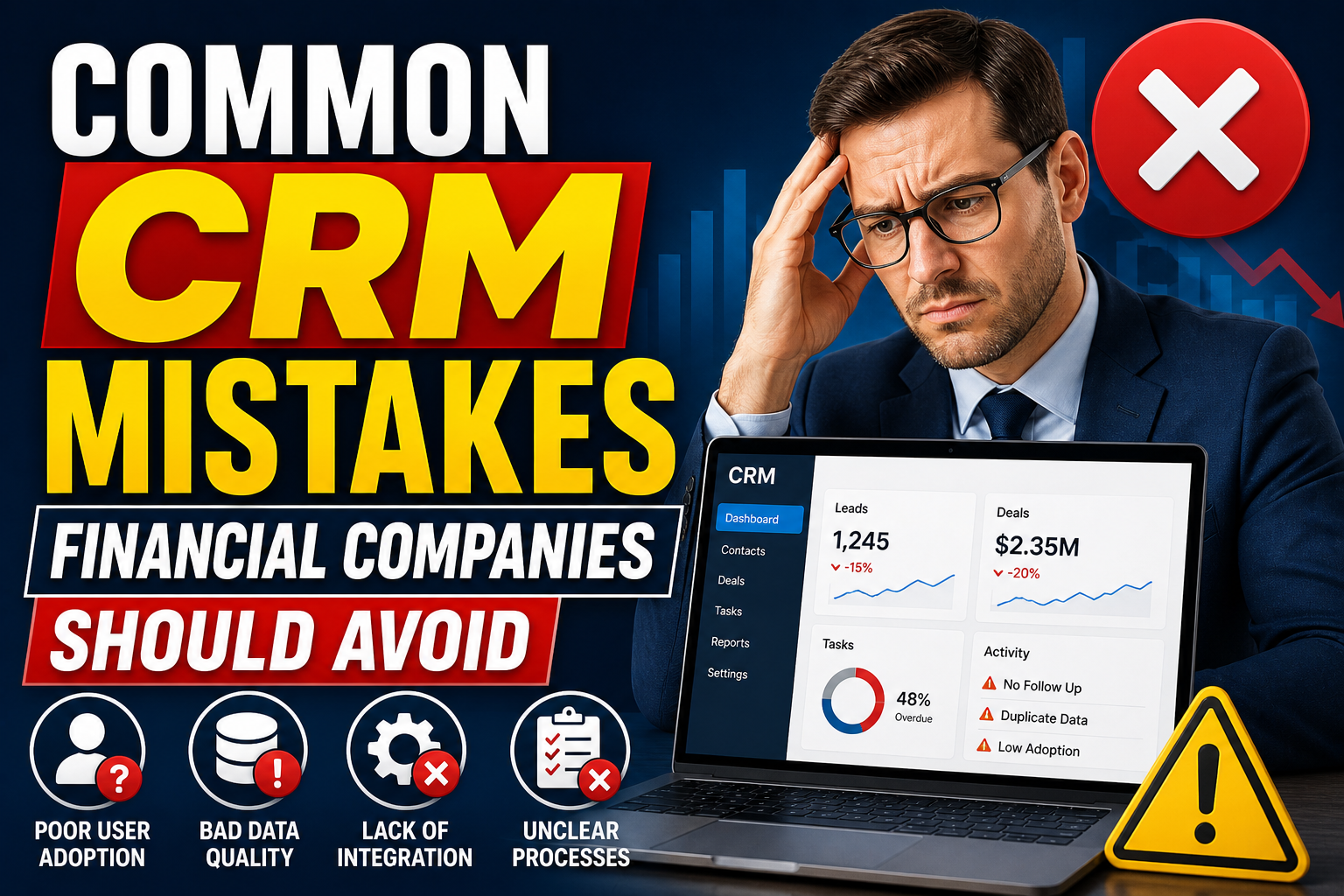
Avoid costly errors by learning the most common CRM mistakes in finance and how to implement your system the right way.
Customer Relationship Management (CRM) systems have become essential in the financial services industry. Whether you are a financial advisor, wealth manager, insurance firm, or banking institution, a well-implemented CRM can streamline client management, improve communication, and drive long-term growth. But here’s the reality: simply having a CRM is not enough. Many financial companies invest in CRM systems but fail to use them effectively.
If you’re not careful, your CRM can turn into just another expensive database instead of a growth engine. Let’s break down the most common CRM mistakes financial companies make and how you can avoid them.
1. Treating CRM as Just a Data Storage Tool
One of the biggest mistakes is using a CRM only as a place to store client information. While storing data is a basic function, a CRM is meant to do much more.
Financial companies often stop at entering client details like name, phone number, and investment history. But they miss out on using that data to generate insights, automate workflows, and improve decision-making.
What to do instead:
Use your CRM to track client behavior, segment customers, and automate follow-ups. For example, set reminders for policy renewals, investment reviews, or important financial milestones.
2. Poor Data Quality and Inconsistent Entry
A CRM is only as good as the data inside it. Many firms struggle with incomplete, outdated, or duplicated records. This leads to confusion, missed opportunities, and poor client experience.
Imagine calling a client and addressing them incorrectly or offering a product they already declined. It damages trust.
Common issues include:
- Duplicate client profiles
- Missing financial details
- Outdated contact information
- Inconsistent formatting
What to do instead:
Set clear data entry standards and enforce them across your team. Regularly clean your database and use validation rules to maintain accuracy.
3. Lack of Team Training
Even the best CRM tools fail if your team doesn’t know how to use them properly. Many financial companies invest in platforms like Salesforce CRM or HubSpot CRM but skip proper onboarding.
As a result, employees either avoid using the system or use it incorrectly.
What to do instead:
Invest time in structured training. Make sure your advisors, relationship managers, and support staff understand:
- How to log interactions
- How to update client records
- How to use automation features
Ongoing training is just as important as initial onboarding.
4. Not Customizing CRM for Financial Workflows
Financial services have very specific workflows. A generic CRM setup won’t work effectively for managing portfolios, compliance tracking, or client risk profiles.
Many companies use default CRM settings without tailoring them to their needs.
What to do instead:
Customize your CRM based on your business model. For example:
- Add fields for investment preferences and risk tolerance
- Track regulatory compliance requirements
- Create pipelines for loan processing or policy issuance
A tailored CRM makes your processes faster and more accurate.
5. Ignoring Compliance and Security Requirements
In the financial industry, compliance is non-negotiable. Mishandling client data can lead to serious legal and financial consequences.
Some firms fail to configure proper security settings in their CRM or overlook audit trails and access control.
Risks include:
- Unauthorized access to sensitive data
- Lack of activity tracking
- Non-compliance with regulations
What to do instead:
Ensure your CRM is configured with:
- Role-based access control
- Data encryption
- Activity logs and audit trails
Always align your CRM setup with regulatory standards applicable in your region.
6. Overcomplicating the CRM System
It’s tempting to add too many features, fields, and workflows. But an overly complex CRM can slow down your team and reduce adoption.
If users find the system confusing, they will avoid using it or input minimal data.
What to do instead:
Keep it simple. Focus on:
- Essential fields
- Clear workflows
- Easy navigation
You can always expand functionality later, but start with a clean and practical setup.
7. Lack of Integration with Other Tools
A CRM should not operate in isolation. Many financial companies fail to integrate their CRM with other systems such as accounting software, email platforms, or marketing tools.
This leads to data silos and duplicated efforts.
What to do instead:
Integrate your CRM with:
- Email systems for communication tracking
- Financial tools for portfolio data
- Marketing platforms for campaign management
This creates a unified system where all data flows seamlessly.
8. Not Using Automation Effectively
Automation is one of the most powerful features of a CRM, yet many companies barely use it.
Manual processes like sending follow-up emails, scheduling meetings, or updating records waste time and increase the risk of errors.
What to do instead:
Use automation for:
- Follow-up reminders
- Client onboarding workflows
- Email sequences
- Task assignments
Automation not only saves time but also ensures consistency in client communication.
9. Failing to Track Client Interactions
In financial services, relationships are everything. If you’re not tracking every interaction with your clients, you’re missing valuable context.
Many firms rely on memory or scattered notes instead of logging interactions in the CRM.
What to do instead:
Record every touchpoint:
- Calls
- Emails
- Meetings
- Service requests
This helps you provide personalized service and maintain continuity, even if a different team member handles the client.
10. No Clear CRM Strategy
A CRM system without a strategy is like a tool without a purpose. Many financial companies implement CRM software without defining clear goals.
Common issues:
- No defined KPIs
- No clear workflows
- No measurement of success
What to do instead:
Define your CRM objectives clearly:
- Improve client retention
- Increase cross-selling
- Enhance client communication
- Streamline operations
Track performance regularly and adjust your strategy based on results.
11. Neglecting Client Segmentation
Not all clients are the same. Treating every client identically is a missed opportunity.
Without segmentation, your communication becomes generic and less effective.
What to do instead:
Segment your clients based on:
- Investment value
- Risk profile
- Age group
- Financial goals
This allows you to deliver more targeted and relevant services.
12. Ignoring Analytics and Reporting
Many CRM systems offer powerful analytics, but companies often ignore these features.
Without data-driven insights, you’re operating blindly.
What to do instead:
Use CRM reports to track:
- Client acquisition trends
- Revenue growth
- Advisor performance
- Client engagement levels
Regular analysis helps you make smarter business decisions.
13. Poor User Adoption Across Teams
A CRM only works if everyone uses it consistently. Partial adoption creates gaps in data and reduces the system’s effectiveness.
What to do instead:
Encourage full adoption by:
- Making CRM usage mandatory
- Simplifying workflows
- Providing incentives for proper usage
Leadership should also lead by example and actively use the CRM.
14. Not Updating the System Regularly
Technology evolves quickly, and so do client expectations. Many firms stick with outdated CRM setups without upgrading features or workflows.
What to do instead:
Review your CRM regularly and:
- Update workflows
- Add new integrations
- Improve automation
Continuous improvement keeps your system aligned with business needs.
Final Thoughts
A CRM system can transform how financial companies manage client relationships, but only if it is used correctly. Avoiding these common mistakes can help you get real value from your investment.
Focus on data quality, team training, customization, and automation. Keep your system simple, integrated, and aligned with your business goals.
If you treat your CRM as a strategic tool rather than just software, it can become one of your strongest assets in building long-term client trust and business growth.
