
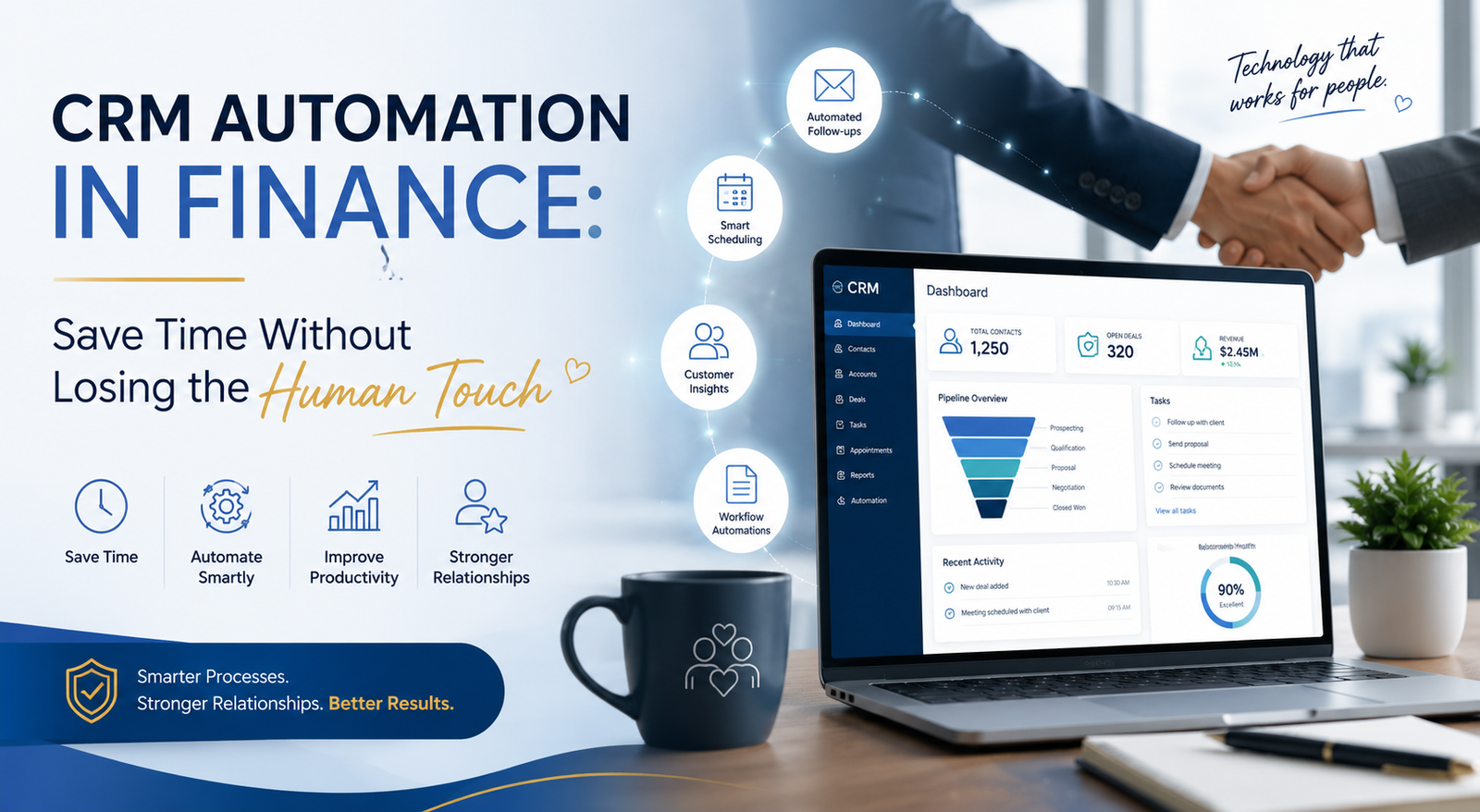
Explore how finance professionals automate reminders, onboarding, and communication using CRM software while maintaining personalized client experiences.
The finance industry runs on relationships. Whether you are a financial advisor, mortgage consultant, insurance broker, wealth manager, or accounting firm, trust is the foundation of every client interaction.
But as client lists grow, manual work becomes a bottleneck.
Missed follow-ups, delayed responses, forgotten renewals, and scattered client notes can quietly damage relationships and reduce revenue. That is why more finance businesses are turning to CRM automation.
The problem is that many firms fear automation will make communication feel robotic.
The good news is that it does not have to.
A well-implemented CRM system can actually make client relationships more personal while saving hours of repetitive work every week.
In this guide, we will look at how CRM automation helps finance businesses scale operations without sacrificing the human touch clients expect.
What Is CRM Automation in Finance?
CRM automation uses software to handle repetitive client management tasks automatically.
Instead of manually sending reminders, updating spreadsheets, tracking emails, or assigning follow-ups, the CRM performs these actions based on predefined workflows.
In the finance sector, CRM automation can help with:
- Lead nurturing
- Appointment scheduling
- Policy renewal reminders
- Client onboarding
- Compliance tracking
- Follow-up emails
- Document collection
- Payment reminders
- Investment review scheduling
- Customer segmentation
The goal is not to replace human advisors.
The goal is to remove repetitive admin work so teams can spend more time building relationships and providing financial guidance.
Why Financial Firms Need CRM Automation
Finance professionals deal with large volumes of sensitive information and time-sensitive communication.
Without automation, teams often face:
- Missed client follow-ups
- Inconsistent communication
- Manual data entry errors
- Slow onboarding processes
- Difficulty managing compliance records
- Poor visibility into client interactions
- Lower client retention
As competition increases, clients now expect fast responses and personalized service.
A CRM system helps firms deliver both consistently.
The Hidden Cost of Manual Processes
Many finance businesses still rely heavily on spreadsheets, email chains, sticky notes, and disconnected tools.
At first, this may seem manageable.
But over time, manual workflows create hidden costs:
Lost Revenue Opportunities
If leads are not followed up quickly, conversion rates drop significantly.
Potential clients often choose the first advisor or firm that responds professionally and consistently.
Reduced Productivity
Financial advisors should spend time advising clients, not updating spreadsheets or chasing paperwork.
Manual administration reduces the number of clients a team can effectively manage.
Poor Client Experience
Clients expect timely updates, reminders, and proactive communication.
Missing a renewal reminder or failing to respond quickly can damage trust.
Compliance Risks
In finance, documentation matters.
Manual tracking increases the risk of missing compliance deadlines or losing important client records.
How CRM Automation Saves Time
1. Automated Lead Management
When a new lead fills out a website form, the CRM can instantly:
- Create a contact profile
- Assign the lead to an advisor
- Send a welcome email
- Schedule a follow-up task
- Track the lead source
This eliminates delays and ensures every lead receives attention immediately.
2. Smart Follow-Up Sequences
Consistent follow-up is critical in finance.
CRM automation can send personalized follow-up emails or reminders based on client behavior.
For example:
- A mortgage lead receives educational emails over two weeks
- An insurance client gets policy renewal reminders automatically
- An investment prospect receives a meeting invitation after downloading a guide
The advisor stays informed while the CRM handles repetitive communication.
3. Faster Client Onboarding
Client onboarding often involves:
- Form collection
- Identity verification
- Document requests
- Signature approvals
- Internal approvals
Automation can streamline this entire process.
Clients receive step-by-step instructions automatically, reducing delays and improving the onboarding experience.
4. Appointment Scheduling Automation
Instead of endless back-and-forth emails, CRM systems can allow clients to:
- View advisor availability
- Book appointments online
- Receive confirmations
- Get automated reminders
This reduces no-shows and saves administrative time.
5. Task and Workflow Automation
CRM systems can automatically assign tasks when specific actions occur.
Examples include:
- Assigning compliance reviews before renewal dates
- Creating follow-up tasks after client meetings
- Triggering annual financial review reminders
- Escalating high-priority leads
This helps teams stay organized without manual oversight.
How to Keep CRM Automation Human
Automation should enhance relationships, not replace them.
The most successful finance firms combine automation with genuine human interaction.
Here is how.
Personalize Every Communication
Avoid generic templates that sound robotic.
Modern CRMs allow personalization using:
- Client names
- Financial goals
- Policy details
- Investment preferences
- Meeting history
- Important dates
Instead of:
“Dear Customer, your renewal is approaching.”
Use:
“Hi Sarah, your life insurance policy renewal is due next month. Let us review your coverage together to ensure it still matches your family’s needs.”
That feels personal because it is relevant.
Automate Timing, Not Empathy
Clients still want human conversations for major financial decisions.
Use automation for:
- Scheduling
- Reminders
- Data collection
- Routine updates
But keep personal interaction for:
- Financial planning
- Investment advice
- Retirement discussions
- Claims support
- Sensitive conversations
The CRM should create more time for meaningful conversations, not eliminate them.
Use Behavioral Triggers Intelligently
CRM automation becomes powerful when based on client behavior.
For example:
- If a client clicks retirement planning content, schedule a retirement consultation follow-up
- If a customer misses a payment reminder, notify the advisor personally
- If a lead repeatedly visits mortgage pages, trigger a tailored outreach
This creates communication that feels timely and relevant.
Maintain Consistent Human Check-Ins
Automation should not replace real relationship management.
Successful finance firms still schedule:
- Quarterly reviews
- Birthday messages
- Annual financial checkups
- Personal follow-up calls
The CRM simply ensures these important touchpoints are never forgotten.
Best CRM Features for Finance Businesses
When choosing a CRM for financial services, prioritize features designed for relationship management and compliance.
Contact Management
A centralized client database with interaction history, notes, and financial details.
Workflow Automation
Automated tasks, reminders, and communication sequences.
Email Integration
Track conversations and automate personalized email workflows.
Compliance Tracking
Secure document storage and audit trails.
Pipeline Management
Monitor leads, opportunities, and conversion stages.
Reporting and Analytics
Track advisor performance, lead conversion, and client retention metrics.
Mobile Access
Allow advisors to access client information on the go.
Industries Benefiting Most From CRM Automation
CRM automation delivers strong value across multiple finance sectors.
Financial Advisors
Manage portfolios, follow-ups, and client reviews efficiently.
Insurance Agencies
Automate renewals, claims communication, and lead nurturing.
Mortgage Brokers
Track loan applications and improve response times.
Accounting Firms
Manage tax deadlines, document requests, and recurring client communication.
Wealth Management Firms
Deliver personalized client experiences at scale.
Common CRM Automation Mistakes to Avoid
Over-Automating Communication
Too many automated messages can feel impersonal.
Balance automation with real human interaction.
Ignoring Data Quality
Automation depends on accurate client data.
Poor data leads to irrelevant communication and client frustration.
Complicated Workflows
Overly complex automations become difficult to manage.
Start simple and optimize gradually.
Lack of Team Training
Even the best CRM fails if staff do not use it properly.
Provide ongoing training and clear processes.
The Future of CRM Automation in Finance
CRM systems are becoming smarter with AI-powered insights and predictive automation.
Modern platforms can now:
- Predict lead conversion likelihood
- Recommend follow-up timing
- Analyze customer engagement
- Detect churn risks
- Personalize communication automatically
But even as technology evolves, one thing remains true:
Finance is still a relationship-driven industry.
Technology should support trust, not replace it.
The firms that succeed will be the ones that combine automation efficiency with authentic client relationships.
