
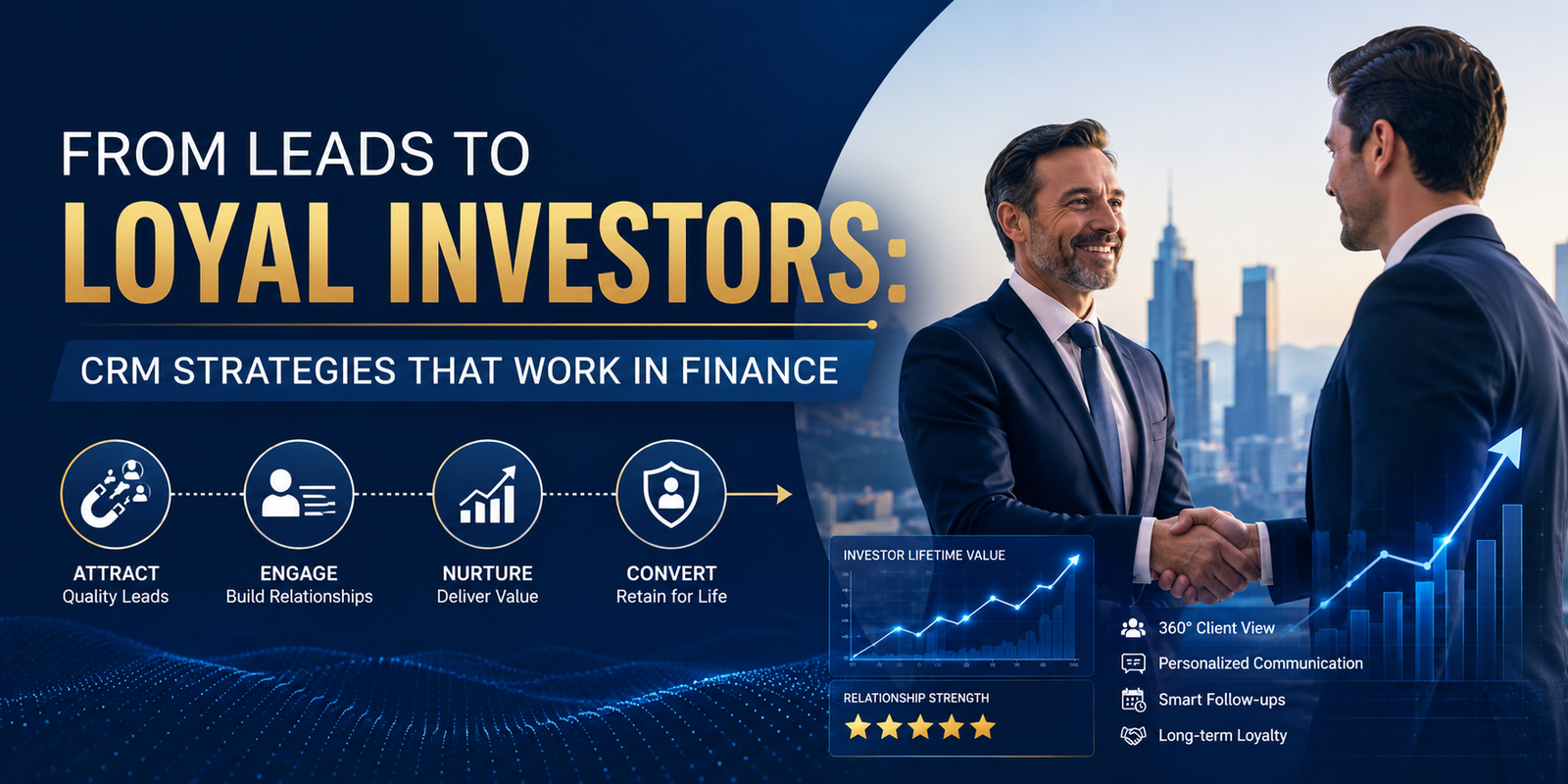
Learn proven CRM strategies financial firms use to convert leads into loyal investors through smarter tracking, automation, and relationship management.
In the financial services industry, relationships are everything. Whether you are a financial advisor, wealth manager, mortgage consultant, insurance provider, or investment firm, long-term trust matters more than quick conversions.
Generating leads is no longer the hardest part. The real challenge is turning those leads into loyal investors who stay with your firm for years, increase their portfolio size, and refer others.
That is where a strong CRM strategy becomes critical.
A modern CRM system does much more than store contact details. It helps finance businesses manage relationships, automate communication, personalize engagement, improve compliance, and create a seamless investor experience.
In this blog, we will break down the CRM strategies that actually work in finance and how they help firms move prospects through every stage of the client journey.
Why CRM Matters in Financial Services
Financial clients expect more today. They want:
- Fast responses
- Personalized financial advice
- Consistent communication
- Transparency
- Trustworthy relationships
- Secure handling of sensitive data
Managing all of this manually becomes difficult as your client base grows.
A CRM helps finance companies:
- Track every lead interaction
- Organize investor data
- Automate follow-ups
- Monitor client behavior
- Improve retention
- Increase cross-selling opportunities
- Build stronger long-term relationships
Without a CRM, many firms lose potential investors simply because follow-ups are delayed or communication feels generic.
The Investor Journey: From Lead to Loyalty
Every financial client goes through multiple stages before becoming loyal.
Stage 1: Lead Generation
This is where prospects first discover your business through:
- Website forms
- Social media campaigns
- Referral programs
- Webinars
- Paid ads
- Email marketing
- Financial seminars
A CRM captures these leads automatically and stores all relevant information in one place.
Instead of using spreadsheets or disconnected tools, your team can instantly view:
- Source of the lead
- Interests
- Financial goals
- Previous interactions
- Communication history
This creates a structured sales pipeline from day one.
Stage 2: Lead Qualification
Not every lead is ready to invest immediately.
Some are researching options while others are actively looking for financial guidance.
A CRM helps categorize leads based on:
- Investment readiness
- Income level
- Risk appetite
- Age group
- Financial goals
- Engagement activity
This allows advisors to focus on high-potential investors while nurturing others gradually.
Lead scoring features inside CRM platforms can prioritize prospects automatically.
For example:
- Someone downloading retirement planning guides repeatedly may receive a higher score.
- A lead attending investment webinars regularly may be marked as sales-ready.
This improves efficiency and conversion rates.
Personalized Communication Builds Trust
Trust is the foundation of financial services.
Generic communication often pushes investors away.
CRM systems help firms personalize communication at scale by tracking:
- Birthdays
- Investment preferences
- Portfolio milestones
- Risk profiles
- Financial goals
- Previous discussions
Instead of sending the same message to everyone, advisors can deliver highly targeted communication.
Examples include:
- Retirement planning updates for older investors
- Tax-saving investment opportunities
- SIP reminders
- Portfolio review invitations
- Market insights based on investment interests
This level of personalization strengthens client relationships significantly.
Automated Follow-Ups Increase Conversions
One of the biggest reasons financial leads go cold is inconsistent follow-up.
A CRM solves this with workflow automation.
You can automate:
- Welcome emails
- Meeting reminders
- Investment maturity notifications
- KYC follow-ups
- Appointment scheduling
- Lead nurturing campaigns
For example:
A prospect downloads an investment guide from your website.
The CRM can automatically:
- Send a thank-you email
- Share related educational content
- Schedule a follow-up reminder for the advisor
- Trigger a consultation invitation after a few days
This keeps prospects engaged without overwhelming your team.
Using Data to Understand Investor Behavior
Modern CRM platforms provide detailed analytics that help firms understand client behavior.
You can track:
- Email open rates
- Website activity
- Investment interests
- Meeting frequency
- Conversion rates
- Client retention metrics
This data helps advisors make smarter decisions.
For example:
If investors interested in retirement planning respond more to educational content than direct sales pitches, your strategy can shift accordingly.
Data-driven communication improves both trust and engagement.
CRM Helps Improve Client Retention
Acquiring a new investor is expensive.
Retaining an existing one is far more profitable.
A CRM helps improve retention by ensuring no client feels ignored.
Key retention strategies include:
Regular Portfolio Reviews
CRMs can automatically remind advisors when clients are due for portfolio reviews.
Consistent check-ins show investors that you actively care about their financial growth.
Proactive Communication
Instead of waiting for clients to contact you during market volatility, advisors can proactively send updates and reassurance.
This builds confidence during uncertain times.
Personalized Financial Milestones
Celebrating milestones strengthens relationships.
Examples include:
- Investment anniversaries
- Goal completion milestones
- Retirement countdown updates
- Education fund achievements
These small touchpoints create emotional loyalty.
CRM and Compliance in Finance
Compliance is a major concern in financial services.
A CRM helps firms maintain proper documentation and communication records.
Benefits include:
- Secure client data storage
- Interaction tracking
- Audit-ready records
- Document management
- Automated compliance reminders
- Reduced manual errors
This is especially important for regulated financial businesses handling sensitive investor information.
Segmentation Creates Better Investor Experiences
Different investors have different needs.
A young professional investing in SIPs requires a different communication approach compared to a high-net-worth investor seeking wealth preservation.
CRM segmentation allows firms to group investors based on:
- Income
- Age
- Investment style
- Risk tolerance
- Portfolio size
- Geographic location
This enables highly relevant communication strategies.
Better relevance leads to higher engagement and stronger trust.
CRM Strategies That Actually Work in Finance
Here are the most effective CRM strategies used by successful finance firms.
1. Centralize All Client Data
Keep every client interaction in one place.
This includes:
- Calls
- Emails
- Documents
- Meeting notes
- Investment preferences
- Service requests
When advisors have complete visibility, client conversations become more meaningful and professional.
2. Build Automated Lead Nurturing Campaigns
Not every lead converts immediately.
Automated educational sequences help maintain engagement over time.
Examples include:
- Beginner investing series
- Retirement planning tips
- Tax-saving strategies
- Market update newsletters
This positions your firm as a trusted advisor rather than just a seller.
3. Use CRM Analytics for Smarter Decisions
Track performance metrics such as:
- Lead conversion rate
- Client acquisition cost
- Retention rate
- Revenue per client
- Engagement trends
These insights help optimize marketing and relationship management strategies.
4. Prioritize Relationship Management Over Sales
Finance is relationship-driven.
Clients stay loyal when they feel understood and supported.
Use your CRM to:
- Schedule regular check-ins
- Remember important personal details
- Follow up consistently
- Offer proactive guidance
Long-term trust creates recurring revenue.
5. Integrate CRM With Other Financial Tools
Modern CRMs work best when integrated with:
- Email platforms
- Accounting software
- Investment platforms
- Marketing automation tools
- Customer support systems
This creates a seamless operational workflow.
The Role of CRM in Investor Education
Educated investors are more confident investors.
CRMs can automate educational content delivery based on investor interests.
Examples include:
- Investment guides
- Risk management articles
- Tax planning resources
- Video explainers
- Market trend updates
Consistent education builds authority and strengthens trust over time.
Measuring CRM Success in Finance
To understand whether your CRM strategy is working, monitor KPIs such as:
- Lead response time
- Conversion rate
- Investor retention rate
- Referral rate
- Customer lifetime value
- Engagement metrics
- Advisor productivity
Improvement in these areas usually indicates stronger relationship management.
The Future of CRM in Financial Services
CRM technology continues evolving rapidly.
Modern finance CRMs now include:
- AI-powered insights
- Predictive analytics
- Automated financial recommendations
- Omnichannel communication
- Advanced personalization
- Behavioral tracking
Firms that adopt these technologies early gain a significant competitive advantage.
Investors increasingly expect personalized digital experiences alongside human expertise.
CRM systems make that possible.
