
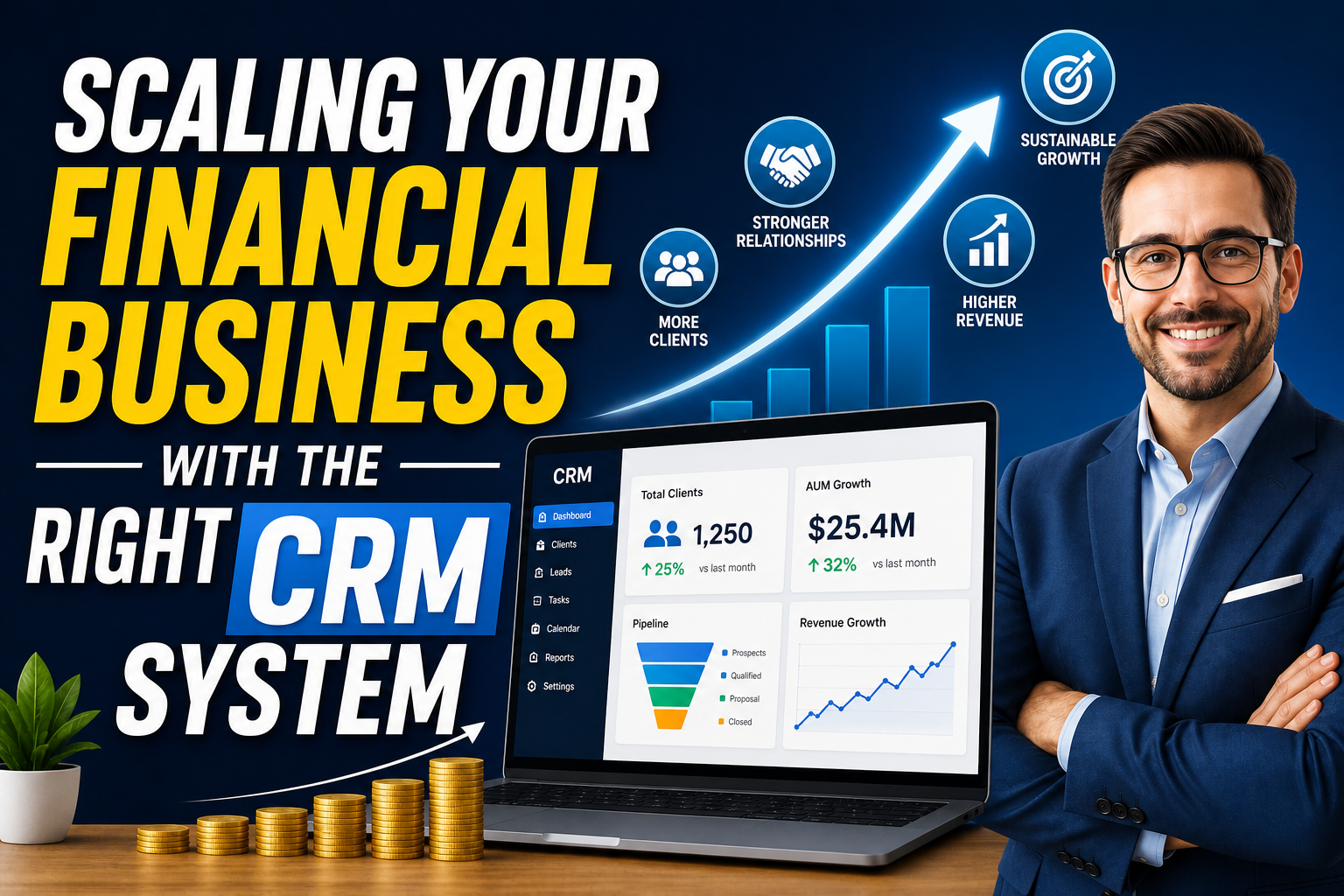
Learn how the right CRM system helps financial firms scale operations, manage clients efficiently, and increase profitability.
In financial services, growth is rarely just about acquiring more clients. It’s about managing relationships at scale without losing the personal touch that builds trust. That’s where a well-implemented CRM (Customer Relationship Management) system becomes a core asset rather than just another tool.
If you’re still relying on spreadsheets, manual follow-ups, or scattered client data, you’ve likely already felt the ceiling. Scaling under those conditions leads to missed opportunities, inconsistent service, and operational bottlenecks. A CRM changes that equation by structuring how you capture, manage, and act on client information.
Let’s break down how the right CRM system helps you scale your financial business in a practical, measurable way.
Why Scaling Financial Services Is Complex
Financial businesses deal with high-value, long-term relationships. Unlike transactional industries, your clients expect:
- Personalized advice
- Timely communication
- Secure data handling
- Consistent follow-ups
As your client base grows, maintaining these standards manually becomes unrealistic. The complexity increases with:
- Regulatory requirements
- Multi-product portfolios
- Diverse client segments
- Long sales cycles
Without a centralized system, you’re essentially trying to scale chaos. A CRM introduces structure and predictability.
What a CRM Actually Does (In Practical Terms)
At its core, a CRM consolidates all client interactions, financial data points, and communication history into a single system. But for financial businesses, a good CRM goes further:
- Tracks client lifecycle from lead to long-term relationship
- Automates reminders for follow-ups, renewals, and reviews
- Segments clients based on behavior, assets, or goals
- Integrates with financial tools and reporting systems
Platforms like Salesforce, HubSpot CRM, and Zoho CRM are commonly used, but the real value comes from how you configure and use the system, not just which one you pick.
1. Centralized Client Data Improves Decision-Making
When your data lives in multiple places, decision-making becomes slow and error-prone. A CRM creates a single source of truth.
Instead of asking:
- “Where is this client’s last interaction recorded?”
- “What products do they already hold?”
You instantly see:
- Full interaction history
- Investment preferences
- Risk profile
- Communication logs
This level of visibility helps you make faster, more informed recommendations. It also reduces dependency on individual team members remembering details.
2. Automation Removes Operational Bottlenecks
Scaling manually means hiring more people just to maintain operations. That approach increases cost without necessarily improving efficiency.
A CRM automates repetitive processes such as:
- Follow-up reminders
- Meeting scheduling
- Email campaigns
- Document tracking
For example, instead of manually tracking when to reconnect with a client, the CRM triggers reminders based on predefined rules. This ensures consistency across your entire client base.
Automation doesn’t replace human interaction. It ensures that interaction happens at the right time.
3. Personalized Client Experience at Scale
Clients expect personalization, especially in financial services. But personalization becomes difficult as your client base grows.
A CRM enables segmentation. You can group clients based on:
- Investment size
- Risk tolerance
- Financial goals
- Lifecycle stage
With this segmentation, you can:
- Send targeted communication
- Offer relevant products
- Schedule timely reviews
For example, a high-net-worth client nearing retirement should not receive the same communication as a young investor starting their journey. CRM systems make this distinction automatic.
4. Improved Lead Management and Conversion
Scaling requires a consistent flow of new clients. But without proper lead management, many opportunities slip through.
A CRM helps you:
- Capture leads from multiple channels
- Assign leads to the right advisors
- Track interactions and follow-ups
- Analyze conversion rates
You can clearly see which leads are:
- Cold
- Warm
- Ready to convert
This visibility allows your team to focus on high-value prospects rather than chasing every inquiry blindly.
5. Better Compliance and Data Security
Financial services operate under strict regulatory frameworks. Managing compliance manually increases risk.
A CRM supports compliance by:
- Maintaining audit trails of all interactions
- Securing client data in structured formats
- Ensuring documentation is consistently stored
- Providing access controls based on roles
This reduces the chances of errors and makes regulatory audits significantly smoother.
6. Team Collaboration Without Information Gaps
As your team grows, coordination becomes a challenge. Without a CRM, information gets siloed.
A CRM ensures that:
- Everyone sees the same client data
- Notes and updates are shared instantly
- Tasks are assigned clearly
- Communication history is transparent
This prevents situations where multiple advisors contact the same client with conflicting information.
7. Data-Driven Growth Strategy
Scaling without analytics is guesswork. A CRM provides insights that guide strategy.
You can track:
- Client acquisition cost
- Lifetime value
- Conversion rates
- Retention metrics
With this data, you can identify:
- Which services generate the most revenue
- Which client segments are most profitable
- Where your sales funnel is leaking
Instead of relying on intuition, you base decisions on actual performance data.
8. Integration with Financial Tools
A CRM becomes even more powerful when integrated with other systems such as:
- Portfolio management tools
- Accounting software
- Email platforms
- Marketing automation tools
For example, integrating with QuickBooks or Xero allows financial data to sync automatically, reducing manual entry and errors.
This creates a connected ecosystem where data flows seamlessly between systems.
Choosing the Right CRM for Your Financial Business
Not all CRMs are built the same. Selecting the right one requires clarity on your specific needs.
Focus on:
1. Industry Fit
Choose a CRM that supports financial workflows like portfolio tracking, compliance, and client segmentation.
2. Scalability
The system should handle increasing data and users without performance issues.
3. Customization
Your processes are unique. The CRM should adapt to your workflow, not the other way around.
4. Ease of Use
If your team finds it complicated, adoption will fail. A simple interface matters.
5. Integration Capability
Ensure it connects with your existing tools.
Common Mistakes to Avoid
Even the best CRM can fail if implemented poorly. Watch out for these issues:
- Overcomplicating the setup
- Not training your team properly
- Migrating incomplete or messy data
- Ignoring user feedback
- Treating CRM as just a storage tool
A CRM should actively support your operations, not just store information.
Real Impact: What Scaling Looks Like with CRM
When implemented correctly, the impact is measurable:
- Faster client onboarding
- Higher conversion rates
- Improved client retention
- Reduced operational workload
- More consistent communication
You’re not just growing in size. You’re improving efficiency and service quality at the same time.
