
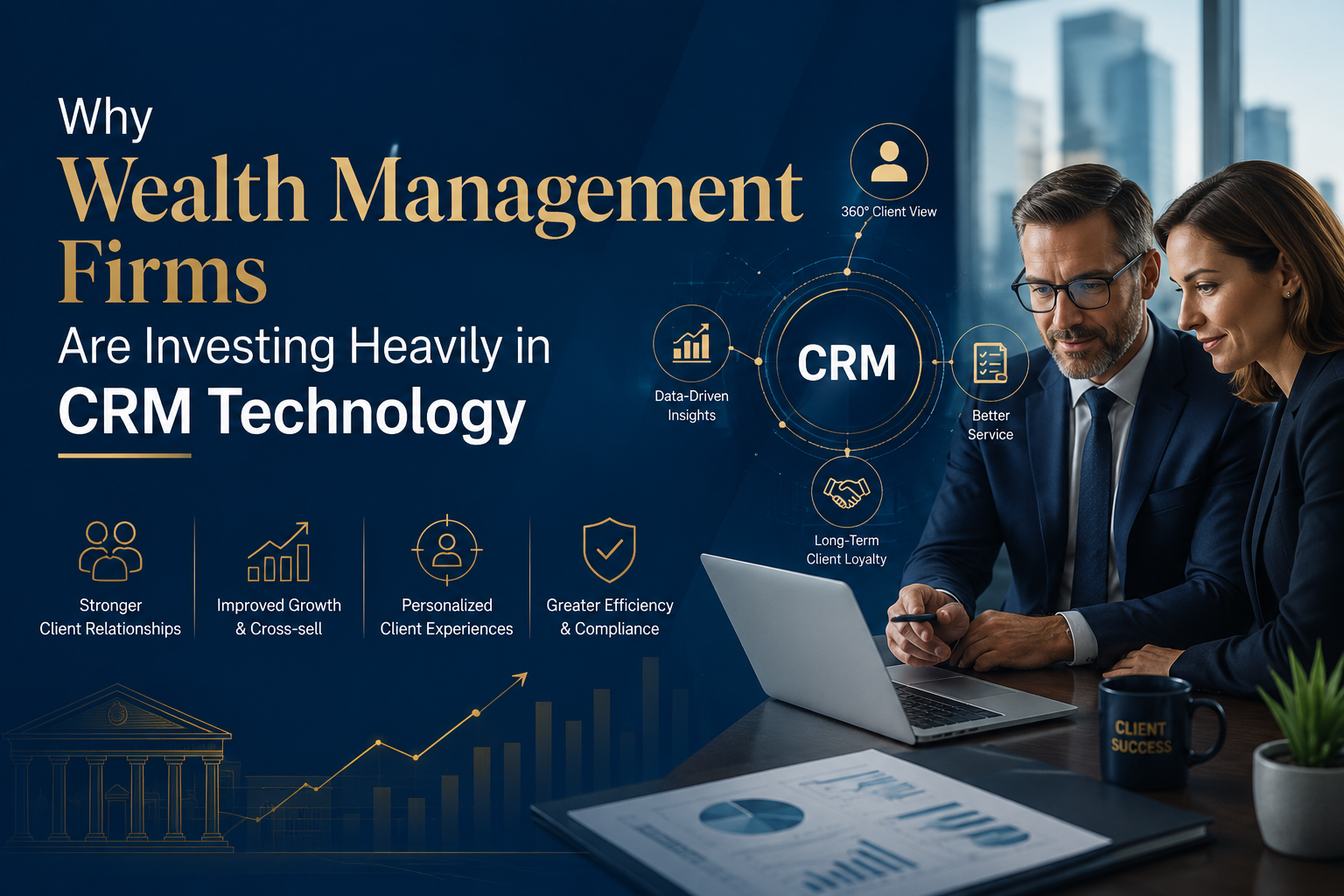
See why modern wealth management firms rely on CRM platforms to improve operational efficiency, client communication, and revenue growth.
The wealth management industry has changed dramatically over the last decade. Clients expect faster communication, personalized financial guidance, digital convenience, and stronger relationships with advisors. At the same time, firms are dealing with tighter regulations, growing competition, and increasing operational complexity.
This is one of the biggest reasons why wealth management firms are investing heavily in CRM technology.
A modern Customer Relationship Management system is no longer just a contact database. It has become the operational backbone of many advisory firms. From client onboarding and portfolio tracking to compliance management and automated communication, CRM platforms are helping firms improve efficiency while delivering a better client experience.
In this blog, we’ll explore why CRM adoption is accelerating in wealth management and how firms are using it to gain a competitive advantage.
The Growing Complexity of Wealth Management
Managing high-net-worth and mass affluent clients is far more complex today than it was a few years ago.
Modern clients expect:
- Personalized investment recommendations
- Faster response times
- Omnichannel communication
- Real-time updates
- Secure document sharing
- Transparent reporting
- Long-term financial planning
At the same time, advisors are handling:
- Regulatory compliance requirements
- Large amounts of financial data
- Multi-generational client relationships
- Portfolio diversification
- Tax planning coordination
- Estate planning discussions
Trying to manage all these moving parts manually or through spreadsheets creates inefficiencies and increases the risk of errors. This is where CRM technology becomes essential.
CRM Technology Helps Centralize Client Data
One of the biggest reasons wealth management firms invest in CRM software is centralized data management.
Without a CRM, client information often gets scattered across:
- Emails
- Excel sheets
- Paper files
- Portfolio management systems
- Meeting notes
- Compliance software
This fragmented approach creates confusion and slows down decision-making.
A CRM platform consolidates everything into a single system. Advisors can quickly access:
- Client profiles
- Financial goals
- Investment history
- Risk tolerance
- Communication records
- Meeting schedules
- Important documents
Having a unified client view helps advisors deliver more informed and personalized advice.
Better Client Relationships Drive Revenue Growth
Relationship management is the foundation of wealth management. Clients trust advisors with highly sensitive financial decisions, and that trust depends heavily on communication and service quality.
CRM systems help firms strengthen client relationships by enabling:
Personalized Communication
Modern CRMs allow advisors to track client preferences, birthdays, investment milestones, and financial goals. This helps create highly personalized interactions instead of generic communication.
Faster Response Times
When all client information is easily accessible, advisors can respond faster to inquiries and provide better support.
Automated Follow-Ups
CRM workflows ensure no client interaction gets missed. Advisors can automate reminders for:
- Portfolio reviews
- Annual meetings
- Tax planning discussions
- Investment updates
- Policy renewals
Improved Client Retention
Clients are more likely to stay with firms that provide proactive service and consistent engagement. CRM systems help firms maintain stronger long-term relationships, which directly impacts retention rates.
CRM Improves Advisor Productivity
Administrative work consumes a significant amount of an advisor’s time. Many firms are investing in CRM platforms to reduce manual tasks and improve operational efficiency.
Automation features help streamline:
- Data entry
- Appointment scheduling
- Task management
- Workflow approvals
- Email campaigns
- Reporting processes
This allows advisors to spend more time focusing on client relationships and financial strategy instead of administrative tasks.
In many firms, CRM adoption has become a direct productivity investment rather than just a software upgrade.
Compliance and Risk Management Are Major Drivers
Regulatory compliance is one of the biggest challenges in the financial services industry. Wealth management firms must maintain detailed records of client interactions, disclosures, and recommendations.
A CRM system helps firms:
- Maintain accurate client records
- Track communication history
- Store signed documents securely
- Monitor advisor activities
- Create audit trails
- Reduce compliance risks
Many CRM platforms also integrate with compliance management tools, making it easier to meet regulatory requirements.
For firms managing large client portfolios, this level of oversight is critical.
Data-Driven Decision Making Is Becoming Essential
Wealth management firms increasingly rely on analytics to improve performance and identify opportunities.
CRM platforms provide insights into:
- Client engagement levels
- Revenue trends
- Advisor performance
- Referral sources
- Conversion rates
- Client segmentation
- Portfolio opportunities
With better data visibility, firms can make smarter business decisions and optimize their growth strategies.
For example, a CRM can help identify high-value clients who may benefit from additional financial products or premium advisory services.
Integration With Financial Technology Ecosystems
Modern wealth management firms use multiple software platforms for:
- Portfolio management
- Financial planning
- Trading
- Compliance
- Marketing automation
- Document management
A CRM acts as a central hub that connects these systems together.
This integration improves operational efficiency by reducing duplicate data entry and ensuring information stays synchronized across platforms.
Popular wealth management CRM platforms often integrate with:
- Custodian platforms
- Investment reporting tools
- Financial planning software
- Email systems
- Calendar applications
This connected ecosystem creates a smoother experience for both advisors and clients.
Client Expectations Are Changing Rapidly
Today’s investors expect the same digital convenience they receive from banks, fintech apps, and eCommerce platforms.
Clients now want:
- Self-service portals
- Instant communication
- Digital onboarding
- Mobile accessibility
- Real-time financial visibility
Wealth management firms that fail to modernize risk losing clients to more technology-driven competitors.
CRM systems help firms deliver modern digital experiences while maintaining the personal touch clients expect from financial advisors.
Scalability Is a Key Advantage
As wealth management firms grow, managing client relationships manually becomes nearly impossible.
CRM platforms make scaling easier by standardizing processes across teams and offices.
Firms can:
- Manage larger client bases efficiently
- Maintain service consistency
- Onboard new advisors faster
- Automate repetitive workflows
- Track performance across departments
This scalability is especially important for firms pursuing aggressive growth strategies through acquisitions or expansion.
AI and Predictive Insights Are Increasing CRM Value
Artificial intelligence is making CRM systems even more valuable for wealth management firms.
Modern CRM platforms now offer AI-powered capabilities such as:
- Predictive client insights
- Automated meeting summaries
- Smart recommendations
- Sentiment analysis
- Lead scoring
- Workflow optimization
AI helps advisors identify opportunities earlier and improve client engagement.
For example, AI can detect when a client may need retirement planning discussions or flag accounts requiring proactive outreach.
This shift is transforming CRM systems from passive databases into intelligent business tools.
CRM Supports Multi-Generational Wealth Planning
Many wealth management firms are preparing for the massive transfer of wealth between generations.
CRM systems help advisors manage complex family relationships by tracking:
- Family structures
- Beneficiaries
- Estate planning details
- Communication preferences
- Shared financial goals
This enables firms to build relationships not just with current clients, but also with future generations.
Long-term relationship continuity is becoming a major competitive advantage in the wealth management industry.
Competitive Pressure Is Accelerating CRM Adoption
Competition in wealth management is intensifying from multiple directions:
- Traditional advisory firms
- Fintech startups
- Robo-advisors
- Private banks
- Digital investment platforms
Firms are investing in CRM technology to differentiate themselves through superior client service and operational efficiency.
Advisors who leverage CRM tools effectively can often manage more clients while maintaining high service quality.
This operational advantage can significantly improve profitability.
Choosing the Right CRM for Wealth Management
Not all CRM systems are designed for financial services.
Wealth management firms typically look for CRM solutions that offer:
- Financial industry compliance support
- Secure data storage
- Workflow automation
- Portfolio integration
- Advanced reporting
- Custom dashboards
- Mobile access
- Client communication tools
Some firms choose industry-specific CRMs, while others customize enterprise CRM platforms to fit their needs.
The right choice depends on factors such as firm size, regulatory requirements, budget, and operational complexity.
