
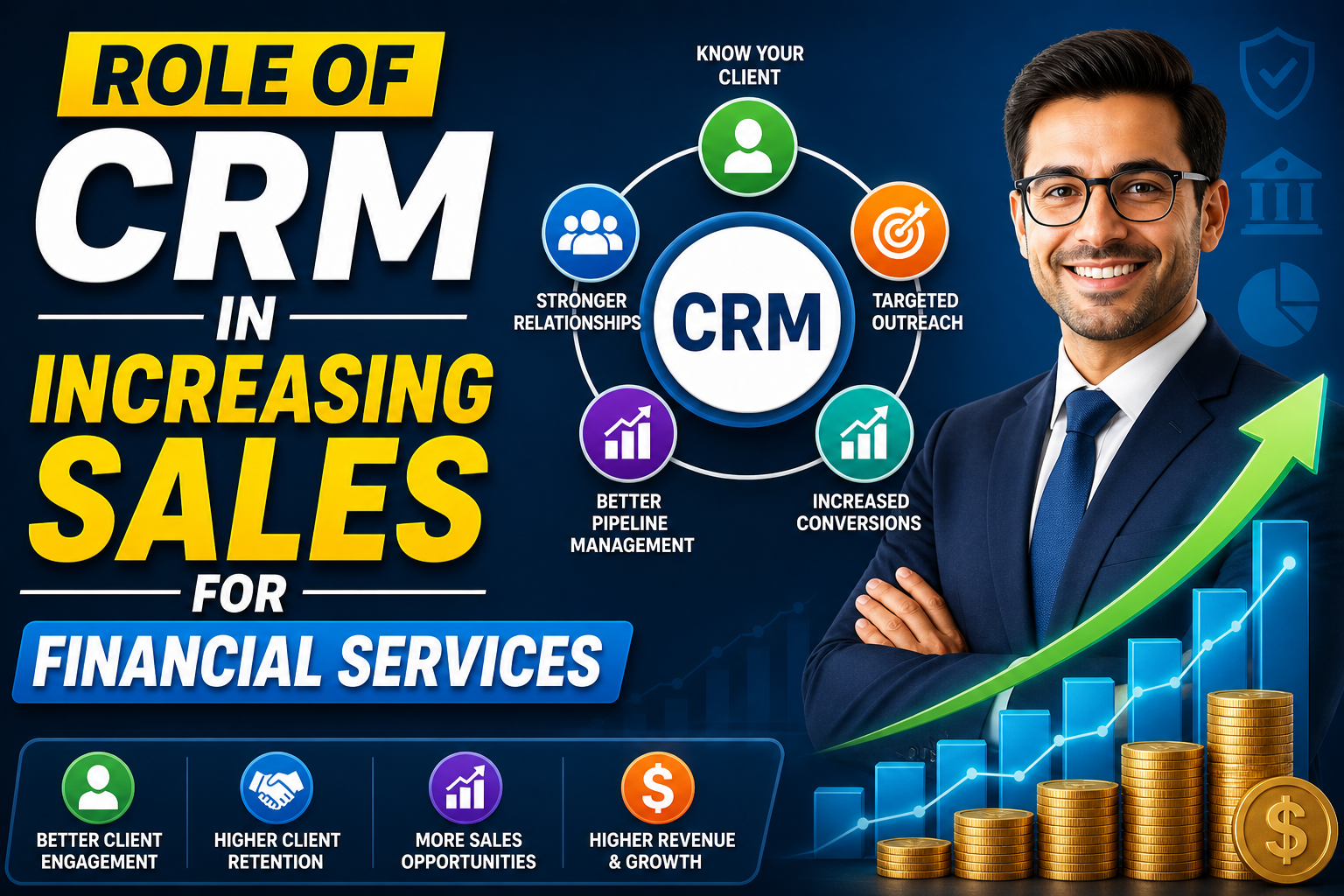
Discover how CRM tools help financial businesses increase sales through better lead tracking, automation, and personalized communication.
In financial services, sales is no longer just about closing deals. It is about building trust, managing long-term relationships, and delivering timely, personalized experiences. Whether you are a financial advisor, wealth manager, insurance agent, or part of a banking team, your ability to manage client data and interactions directly impacts your revenue.
This is where a CRM (Customer Relationship Management) system becomes essential. A well-implemented CRM does not just store contact details. It acts as the central engine that drives smarter sales decisions, improves client engagement, and ultimately increases revenue.
Let’s break down how CRM plays a direct role in boosting sales in financial services.
What is CRM in Financial Services?
A CRM system is a platform that helps financial professionals manage client information, track interactions, automate workflows, and analyze data.
Popular CRM platforms like Salesforce CRM, HubSpot CRM, and Zoho CRM are widely used in the finance industry.
In financial services, CRM is specifically tailored to handle:
- Sensitive financial data
- Compliance requirements
- Relationship-based selling
- Long sales cycles
Why CRM is Critical for Sales Growth
Financial products are often complex and high-value. Clients take time to make decisions, and they expect personalized guidance.
Without a CRM, sales teams often struggle with:
- Scattered client data
- Missed follow-ups
- Poor communication
- Lack of visibility into sales pipelines
CRM solves these issues and creates a structured system that directly supports revenue growth.
1. Centralized Client Data Improves Sales Efficiency
One of the biggest advantages of CRM is having all client data in one place.
Instead of switching between spreadsheets, emails, and notes, a CRM provides:
- Complete client profiles
- Transaction history
- Communication records
- Financial preferences
This helps sales teams:
- Understand client needs faster
- Reduce time spent searching for information
- Deliver more relevant recommendations
When your team spends less time managing data and more time engaging clients, sales naturally increase.
2. Better Lead Management and Conversion
In financial services, leads come from multiple channels:
- Referrals
- Websites
- Campaigns
- Events
CRM helps track every lead from the first interaction to conversion.
Key benefits include:
- Lead scoring to prioritize high-value prospects
- Automated follow-ups to prevent missed opportunities
- Clear pipeline visibility
For example, if a lead shows interest in investment planning, CRM can trigger reminders for follow-ups and assign the lead to the right advisor.
This structured approach significantly improves conversion rates.
3. Personalized Client Engagement Drives More Sales
Modern clients expect personalized service. Generic communication no longer works.
CRM allows you to:
- Segment clients based on behavior and preferences
- Send targeted recommendations
- Track important life events (birthdays, financial milestones, etc.)
For instance, if a client recently received a bonus, CRM insights can prompt advisors to suggest investment plans or tax-saving instruments.
This level of personalization builds trust, and trust leads to higher sales.
4. Automation Reduces Manual Work
Sales teams in financial services often deal with repetitive tasks like:
- Sending follow-up emails
- Scheduling meetings
- Updating records
CRM automates these processes.
Automation features include:
- Email workflows
- Task reminders
- Appointment scheduling
- Document tracking
This allows sales professionals to focus on high-value activities like client meetings and strategic planning.
More time spent on meaningful interactions directly impacts revenue growth.
5. Improved Sales Pipeline Visibility
CRM gives a clear view of the entire sales pipeline.
You can track:
- Number of active leads
- Stage of each deal
- Expected revenue
- Conversion rates
This visibility helps managers:
- Identify bottlenecks
- Forecast revenue accurately
- Allocate resources effectively
For example, if many deals are stuck in the proposal stage, it signals a need to improve proposal quality or follow-up strategy.
Better pipeline management leads to more closed deals.
6. Cross-Selling and Upselling Opportunities
Financial services rely heavily on cross-selling and upselling.
A CRM system helps identify opportunities by analyzing client data.
Examples:
- Offering insurance to a loan customer
- Suggesting mutual funds to savings account holders
- Recommending retirement plans to mid-career professionals
CRM tracks client behavior and financial patterns, making it easier to suggest the right products at the right time.
This increases the lifetime value of each client.
7. Stronger Client Relationships and Retention
In finance, retaining clients is just as important as acquiring new ones.
CRM helps maintain consistent communication by:
- Sending reminders for policy renewals
- Tracking service requests
- Logging every interaction
Clients feel valued when communication is timely and relevant.
Stronger relationships lead to:
- Repeat business
- Referrals
- Higher customer lifetime value
Retention directly contributes to sustained sales growth.
8. Data-Driven Decision Making
CRM provides detailed analytics and reports.
You can measure:
- Sales performance
- Lead conversion rates
- Campaign effectiveness
- Client engagement levels
This data helps businesses make informed decisions instead of relying on guesswork.
For example:
- If a campaign generates high-quality leads, you can scale it
- If a product has low conversion, you can refine your sales approach
Data-driven strategies consistently outperform intuition-based decisions.
9. Compliance and Risk Management
Financial services operate under strict regulations.
CRM systems help ensure compliance by:
- Maintaining accurate records
- Tracking communication history
- Managing documentation
This reduces the risk of errors and legal issues.
A compliant sales process builds credibility and trust, which indirectly supports higher sales.
10. Mobility and Remote Access
Modern CRM systems are cloud-based, allowing access from anywhere.
Sales teams can:
- Update client information on the go
- Access data during meetings
- Respond quickly to client queries
This flexibility improves responsiveness and client satisfaction.
Faster responses often translate into higher chances of closing deals.
Best Practices for Using CRM to Increase Sales
To get maximum value from CRM, financial businesses should follow these practices:
1. Customize CRM for Financial Workflows
Generic setups do not work well. Tailor the CRM to match your sales process and compliance needs.
2. Train Your Sales Team Properly
A CRM is only effective if your team uses it consistently.
3. Keep Data Clean and Updated
Outdated or incorrect data reduces CRM effectiveness.
4. Use Automation Smartly
Automate repetitive tasks but keep human interaction where it matters.
5. Monitor Performance Regularly
Use CRM analytics to continuously improve your sales strategy.
Challenges to Watch Out For
While CRM offers many benefits, there are some challenges:
- Resistance to adoption by sales teams
- Poor data entry practices
- Overcomplicated workflows
- Lack of proper training
Addressing these early ensures smooth implementation and better ROI.
Future of CRM in Financial Services
CRM is evolving rapidly with new technologies like:
- Artificial Intelligence (AI)
- Predictive analytics
- Chatbots
- Advanced automation
These innovations will make CRM even more powerful in driving sales.
For example, AI can predict which clients are most likely to invest, helping advisors focus on high-probability opportunities.
Conclusion
The role of CRM in increasing sales for financial services is both strategic and practical.
It helps businesses:
- Organize client data
- Improve lead management
- Deliver personalized experiences
- Automate processes
- Make data-driven decisions
In a competitive financial market, relying on manual processes is no longer sustainable.
A well-implemented CRM system not only improves efficiency but also builds stronger client relationships, which is the foundation of long-term sales success.
If your goal is to scale your financial business, improve conversions, and maximize client value, investing in CRM is not optional. It is essential.
