
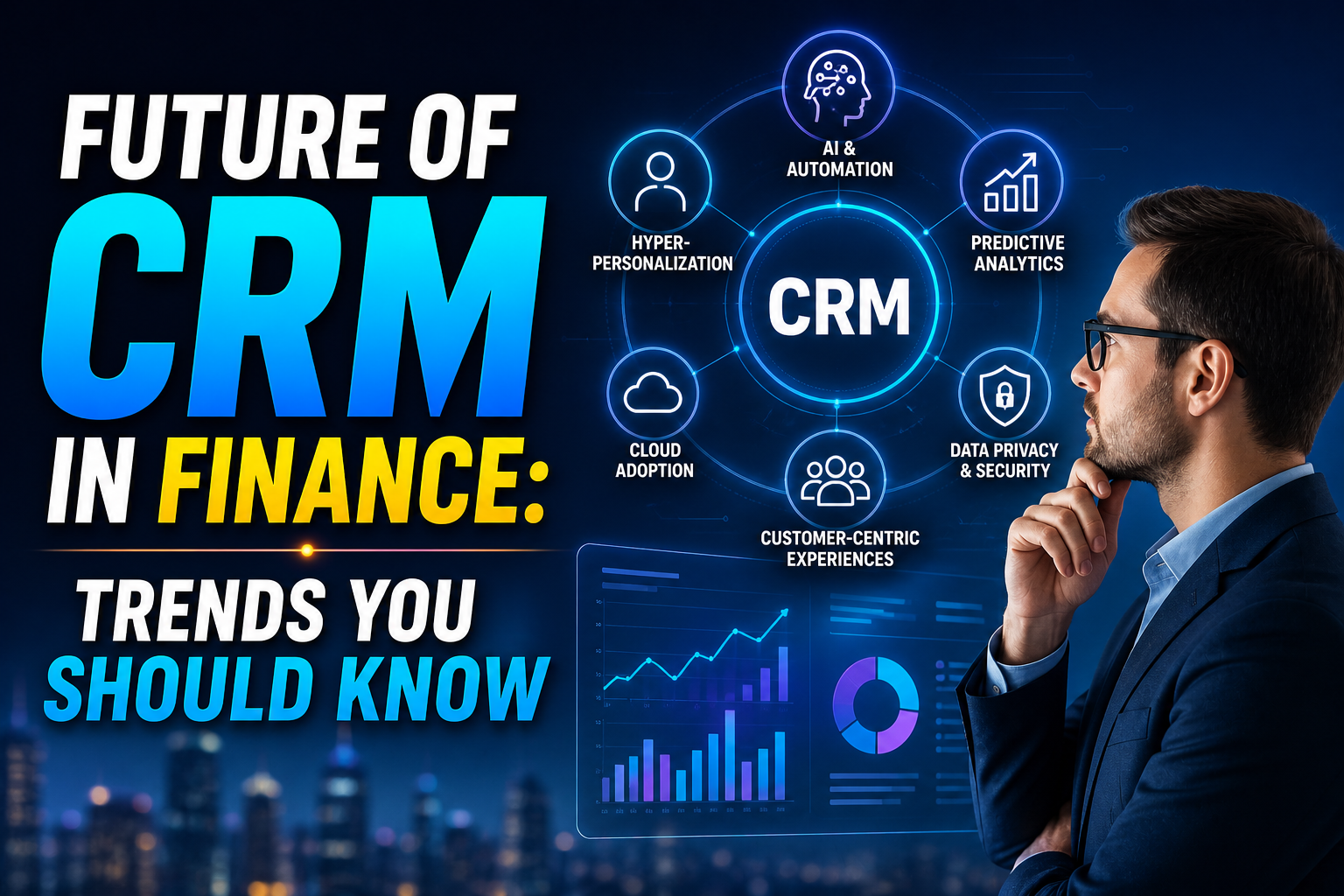
Stay ahead with the latest CRM trends in the financial sector, including AI, automation, and data-driven decision making.
The financial services industry is going through a major shift, and CRM (Customer Relationship Management) is right at the center of it. What used to be a basic tool for storing client data is now becoming an intelligent system that drives decision-making, improves customer experience, and ensures compliance.
If you are working in finance or planning to build products in this space, understanding where CRM is heading is not optional anymore. It directly impacts how you acquire, manage, and retain clients.
Let’s break this down in a practical way so you can clearly see what’s coming and how it affects you.
What is Changing in Financial CRM?
Traditionally, CRM systems were used mainly for record-keeping and tracking interactions. But now, they are evolving into real-time decision engines powered by AI, automation, and data integration.
Modern finance CRMs already help firms:
- Centralize client data
- Improve personalization
- Manage compliance
- Increase operational efficiency
But the next phase is much more advanced.
1. AI-Driven CRM Will Become the Core
The biggest shift is AI moving from support to control.
Earlier:
- CRM suggested actions
Now: - CRM takes actions automatically
This concept is called Agentic AI.
In 2026, CRM systems are expected to:
- Automatically update customer profiles
- Adjust campaigns in real-time
- Predict next best actions without manual input
Gartner predicts that around 40% of enterprise apps will include AI agents by 2026
Why this matters in finance:
- Faster loan approvals
- Smarter investment recommendations
- Reduced manual errors
In simple terms, CRM will act like a digital relationship manager, not just a database.
2. Hyper-Personalization Will Define Customer Experience
Customers today expect personalized financial services.
CRM systems are now using:
- Behavioral data
- Transaction history
- Real-time activity
to deliver highly customized experiences.
Financial institutions can:
- Recommend investment products
- Offer tailored loan options
- Send targeted financial advice
AI-powered personalization is becoming a major competitive advantage in finance
Real-world impact:
Instead of generic emails, customers receive:
- “Based on your spending, here’s a better credit option”
- “You may benefit from this investment plan”
This level of personalization increases trust and retention.
3. Real-Time Data Will Replace Static Reports
Finance is moving toward continuous, real-time operations.
CRM systems will no longer rely on:
- Weekly reports
- Delayed data
Instead, everything will be live.
Real-time data helps:
- Detect risks early
- Adjust financial strategies instantly
- Improve forecasting accuracy
Continuous finance is becoming the new standard, with real-time data driving faster decisions
Why it matters:
In finance, timing is critical. A delay in data can mean:
- Missed opportunities
- Financial losses
CRM systems will act as live dashboards for decision-making.
4. Integration with Fintech and Open Banking
CRM systems will not work in isolation anymore.
They will integrate with:
- Banking systems
- Payment platforms
- Investment tools
- Fintech apps
This is driven by open banking and API ecosystems.
Open banking allows third-party services to:
- Access financial data securely
- Deliver better services across platforms
Example:
A CRM can:
- Pull data from multiple bank accounts
- Analyze spending patterns
- Suggest financial planning strategies
This creates a connected financial ecosystem.
5. Automation Will Move Toward Hyper-Automation
Automation is already common, but now it’s evolving into hyper-automation.
This means combining:
- AI
- Machine learning
- Analytics
- Workflow automation
to automate entire processes.
Examples in finance:
- Automated KYC verification
- Loan processing
- Compliance checks
Hyper-automation improves:
- Efficiency
- Accuracy
- Cost savings
It also allows teams to focus on high-value tasks instead of repetitive work.
6. Compliance and Data Security Will Become Central
Finance is one of the most regulated industries.
As CRM becomes more advanced, compliance will become a built-in feature, not an add-on.
Key focus areas:
- Data privacy
- Consent management
- Audit trails
- Risk monitoring
AI governance is becoming essential to ensure CRM systems operate safely and legally
Why this matters:
With stricter regulations:
- Non-compliance = heavy penalties
- Data breaches = loss of trust
Future CRM systems will include automated compliance checks.
7. Cloud-Based CRM Will Dominate
Legacy systems are slowly disappearing.
Financial institutions are shifting to:
- Cloud-based CRM platforms
Benefits:
- Scalability
- Lower infrastructure cost
- Faster deployment
- Easy updates
Cloud migration is a key part of digital transformation in finance
Impact:
Even small financial firms can now:
- Access enterprise-level CRM tools
- Compete with larger players
8. Composable CRM Will Replace One-Size-Fits-All Systems
Earlier, companies used one large CRM system for everything.
Now, the trend is Composable CRM.
This means:
- Using multiple specialized tools
- Connecting them through APIs
For example:
- One tool for sales
- One for marketing
- One for compliance
All connected into one system.
Composable CRM offers:
- Flexibility
- Better performance
- Easier customization
9. Voice and Conversational CRM
CRM systems are becoming easier to use.
Instead of typing, users can:
- Speak commands
- Ask questions
Voice CRM allows:
- Hands-free data entry
- Meeting transcription
- Quick data retrieval
This improves:
- Productivity
- User adoption
10. CRM Will Shift from Data Storage to Decision Engine
This is the biggest long-term change.
CRM is no longer just:
- A system to store data
It is becoming:
- A system that tells you what to do next
Modern CRM platforms are evolving into proactive tools that guide actions in real time, rather than just storing information
Example:
Instead of:
- “Here is your client data”
CRM will say:
- “This client is likely to churn. Contact them now.”
Key Benefits of Future CRM in Finance
If you look at all these trends together, the outcome is clear.
Future CRM systems will help financial businesses:
- Improve customer relationships
- Increase revenue
- Reduce operational costs
- Stay compliant
- Make faster decisions
Challenges You Should Be Ready For
It’s not all smooth.
Some real challenges include:
1. Data Quality Issues
AI only works if your data is clean.
2. Integration Complexity
Connecting multiple systems can be difficult.
3. High Initial Investment
Advanced CRM systems can be expensive.
4. Skill Gap
Teams need training to use modern CRM tools.
Final Thoughts
The future of CRM in finance is not just about better software. It’s about a complete shift in how financial businesses operate.
We are moving from:
- Reactive systems → Proactive systems
- Manual work → Automated intelligence
- Generic services → Personalized experiences
If you adopt these trends early, you gain a serious advantage.
If you ignore them, you risk falling behind.
