
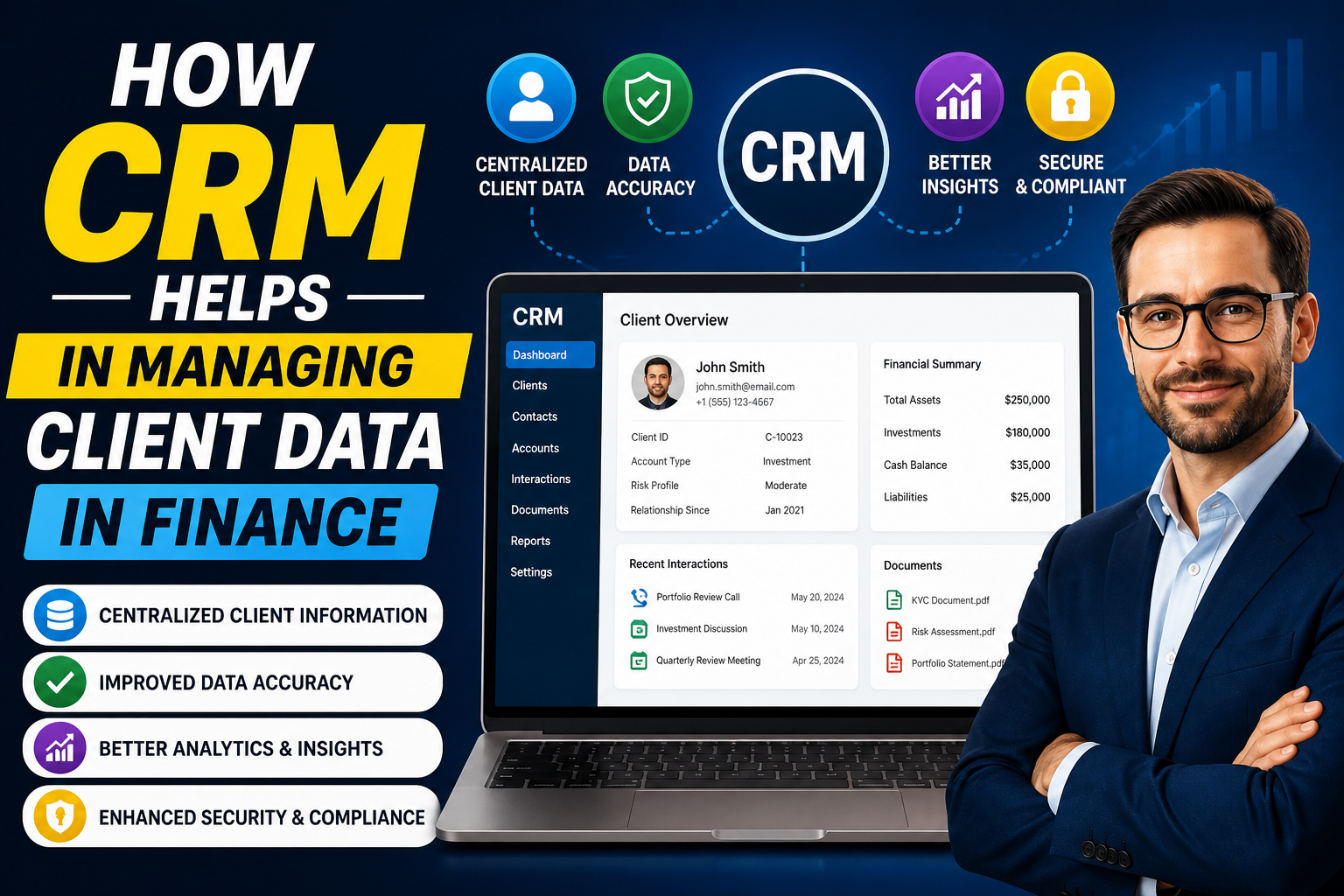
Learn how CRM systems simplify client data management in finance while ensuring accuracy, security, and easy accessibility.
In the financial services industry, data is everything. Whether it’s a bank, investment firm, insurance company, or fintech startup, managing client data efficiently is critical for growth, compliance, and customer satisfaction. This is where a Customer Relationship Management (CRM) system becomes essential.
A modern CRM like Salesforce CRM, HubSpot CRM, or Zoho CRM is not just a contact database. It’s a centralized platform that helps financial institutions organize, analyze, secure, and leverage client data effectively.
This blog breaks down how CRM helps in managing client data in finance, why it matters, and how firms can use it to gain a competitive edge.
Why Client Data Management Matters in Finance
Financial institutions deal with highly sensitive and complex data. This includes:
- Personal identification details
- Transaction history
- Investment portfolios
- Risk profiles
- Compliance records
Without a structured system, this data can become fragmented across spreadsheets, emails, and multiple software tools. That leads to inefficiencies, errors, and compliance risks.
A CRM solves this by acting as a single source of truth for all client-related information.
Centralized Data Storage
One of the biggest advantages of CRM in finance is centralized data management.
Instead of storing client data in different systems, a CRM consolidates everything into one unified platform. Every interaction, transaction, and document is linked to the client profile.
Benefits:
- Easy access to complete client history
- Reduced data duplication
- Improved team collaboration
- Faster decision-making
For example, when a relationship manager opens a client profile, they can instantly see past interactions, current investments, and communication history. No need to switch between tools.
Improved Data Accuracy and Consistency
Manual data entry across multiple systems often leads to inconsistencies and errors. In finance, even a small mistake can have serious consequences.
CRM systems enforce structured data entry with standardized fields and validation rules.
How CRM improves accuracy:
- Auto-fill and data validation
- Integration with financial systems
- Real-time updates across teams
- Duplicate detection
This ensures that everyone in the organization works with accurate and up-to-date information.
Enhanced Client Segmentation
Not all clients are the same. Some are high-net-worth individuals, while others may be retail investors. Each group requires a different approach.
CRM platforms allow financial institutions to segment clients based on:
- Income level
- Investment behavior
- Risk tolerance
- Location
- Lifecycle stage
Why segmentation matters:
- Personalized financial advice
- Targeted marketing campaigns
- Better product recommendations
- Improved client engagement
For example, a CRM can help identify clients interested in mutual funds and automatically assign them to relevant campaigns.
Personalized Customer Experience
In today’s competitive market, personalization is not optional. Clients expect tailored financial advice and communication.
CRM systems enable financial advisors to deliver highly personalized experiences by using client data effectively.
How CRM supports personalization:
- Tracks client preferences and goals
- Stores interaction history
- Provides reminders for key events (birthdays, renewals)
- Suggests relevant financial products
When a client feels understood, they are more likely to trust the institution and stay loyal.
Stronger Compliance and Data Security
Financial services are heavily regulated. Firms must comply with laws related to data protection, anti-money laundering (AML), and know-your-customer (KYC) requirements.
CRM systems help manage compliance efficiently.
Key compliance features:
- Secure data storage with encryption
- Audit trails of all interactions
- Role-based access control
- Automated compliance workflows
For example, a CRM can track whether KYC documents are complete and alert teams if something is missing.
This reduces legal risks and ensures that the organization stays compliant with regulations.
Better Client Relationship Management
As the name suggests, CRM is designed to improve relationships.
Financial advisors can use CRM tools to maintain consistent communication with clients.
Features that improve relationships:
- Task and follow-up reminders
- Email and call tracking
- Meeting scheduling
- Notes and interaction logs
This ensures that no client is overlooked and every interaction is meaningful.
For instance, if a client recently invested in a product, the advisor can schedule a follow-up to discuss performance.
Data-Driven Decision Making
CRM systems don’t just store data. They help analyze it.
With built-in analytics and reporting tools, financial institutions can gain valuable insights.
Insights CRM can provide:
- Client profitability
- Investment trends
- Sales performance
- Customer retention rates
These insights help organizations make smarter decisions.
For example, if data shows that a certain investment product is popular among a specific client segment, firms can focus their marketing efforts accordingly.
Automation of Routine Tasks
Financial professionals often spend a lot of time on repetitive tasks like data entry, follow-ups, and report generation.
CRM systems automate these tasks, saving time and improving efficiency.
Examples of automation:
- Sending automated emails
- Updating client records
- Scheduling follow-ups
- Generating reports
This allows teams to focus on higher-value activities like client advisory and strategy.
Seamless Integration with Financial Tools
A CRM becomes even more powerful when integrated with other systems such as:
- Accounting software
- Portfolio management tools
- Banking systems
- Marketing platforms
Platforms like Microsoft Dynamics 365 offer strong integration capabilities.
Benefits of integration:
- Real-time data synchronization
- Reduced manual work
- Better data visibility
- Improved workflow efficiency
For example, when a transaction happens in a banking system, it can automatically reflect in the CRM.
Scalability for Growing Financial Firms
As financial institutions grow, managing client data becomes more complex.
CRM systems are built to scale with business growth.
Scalability features:
- Handles large volumes of data
- Supports multiple users and teams
- Customizable workflows
- Cloud-based access
Whether a firm has 100 clients or 100,000, a CRM can manage data efficiently.
Real-World Use Cases
1. Wealth Management Firms
Advisors use CRM to track client portfolios, preferences, and financial goals. This helps in delivering personalized investment advice.
2. Banks
Banks use CRM to manage customer accounts, loans, and transaction histories while ensuring compliance.
3. Insurance Companies
CRM helps track policies, claims, and renewals, ensuring timely communication with clients.
4. Fintech Startups
Startups use CRM to scale quickly, manage user data, and automate customer interactions.
Challenges Without CRM
To understand the value of CRM, it helps to look at what happens without it:
- Data scattered across multiple platforms
- Poor client communication
- Increased risk of errors
- Compliance issues
- Limited visibility into client behavior
These challenges can slow down growth and damage client trust.
Choosing the Right CRM for Finance
Not all CRM systems are the same. Financial institutions should look for:
- Strong data security features
- Compliance support
- Customization options
- Integration capabilities
- User-friendly interface
Popular options like Salesforce CRM, Zoho CRM, and HubSpot CRM are widely used in the industry.
The right choice depends on business size, budget, and specific needs.
