
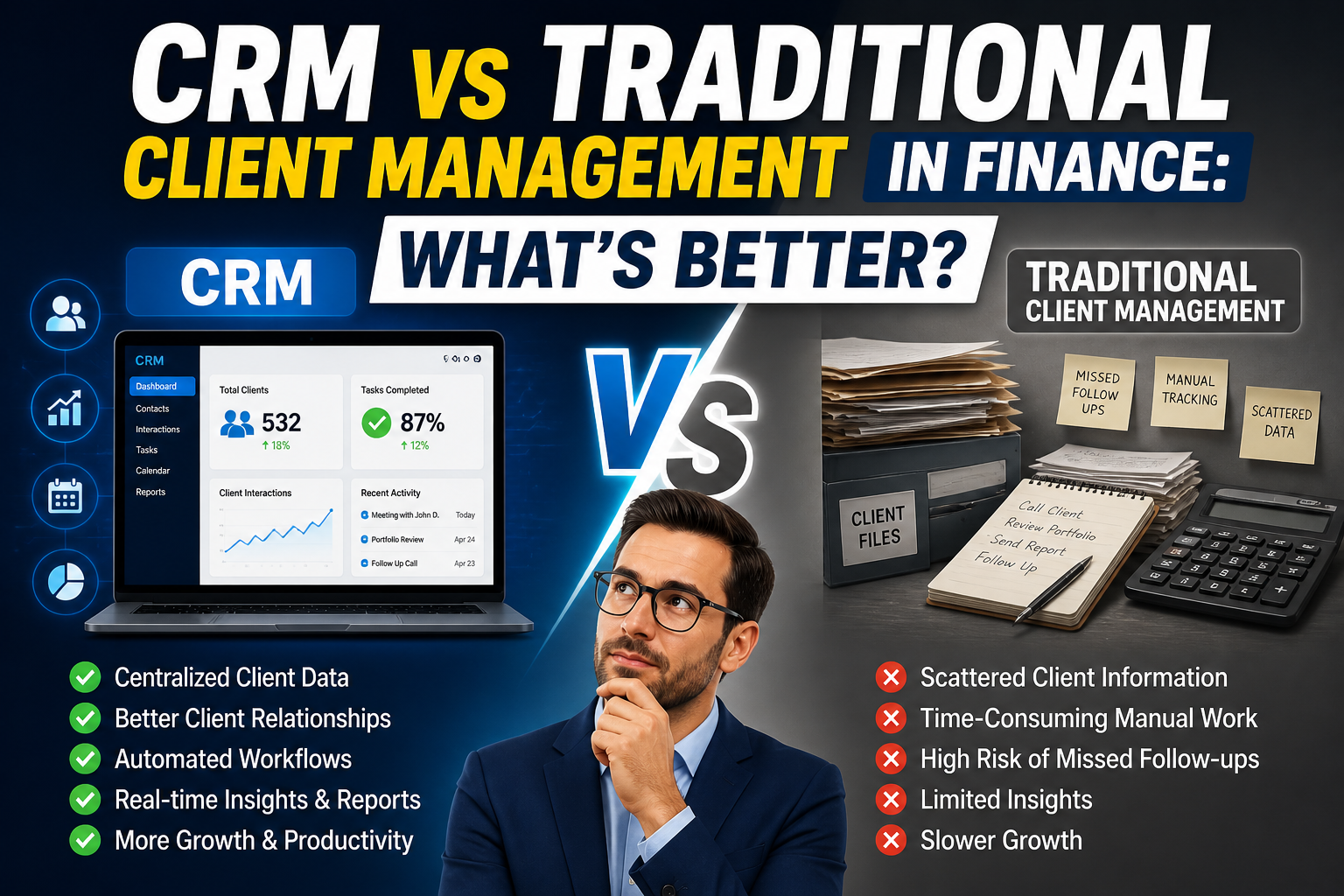
Compare CRM systems with traditional client management methods and find out which approach works best for financial businesses.
In financial services, how you manage client relationships directly impacts revenue, compliance, and long-term trust. For years, advisors, wealth managers, and finance firms relied on spreadsheets, notebooks, and email chains to track client data. That approach is what we call traditional client management.
Today, most modern firms are shifting toward Customer Relationship Management (CRM) systems such as Salesforce CRM or HubSpot CRM. But is CRM actually better, or does traditional client management still hold value?
Let’s break this down in a practical, no-nonsense way.
What is Traditional Client Management?
Traditional client management refers to manual or semi-digital ways of handling client information. This usually includes:
- Excel sheets or Google Sheets
- Physical files and paperwork
- Email-based communication tracking
- Personal notes or diaries
This method depends heavily on the individual advisor’s memory and organization skills.
Where It Works Well
Traditional methods still work in small setups:
- Independent financial advisors with limited clients
- Small firms with simple workflows
- Situations where personalization matters more than scale
But once client volume grows, cracks start to show.
What is CRM in Finance?
A CRM system is software designed to centralize, organize, and automate client data and interactions. In finance, it goes beyond basic contact storage.
A financial CRM helps with:
- Client onboarding
- Portfolio tracking integration
- Compliance documentation
- Automated communication
- Task and follow-up management
Think of it as a centralized command center for your client relationships.
Core Differences Between CRM and Traditional Methods
1. Data Organization
Traditional systems scatter data across files, emails, and folders. Finding one client detail can take minutes or longer.
CRM systems store everything in one place:
- Contact details
- Financial history
- Interaction logs
- Documents
This creates a single source of truth.
Verdict: CRM clearly wins.
2. Efficiency and Time Management
With traditional management:
- You manually update records
- You rely on memory for follow-ups
- You spend time searching for data
CRM automates many of these tasks:
- Automatic reminders
- Scheduled follow-ups
- Workflow automation
This saves hours every week.
Verdict: CRM is significantly more efficient.
3. Client Experience
In finance, relationships are everything.
Traditional management often leads to:
- Missed follow-ups
- Generic communication
- Delayed responses
CRM allows:
- Personalized messaging
- Timely engagement
- Complete visibility into client history
For example, you instantly know when a client last invested or contacted you.
Verdict: CRM delivers a better client experience.
4. Scalability
Traditional systems struggle as your business grows.
Managing 20 clients manually is manageable. Managing 200 is chaos.
CRM systems are built for scale:
- Handle thousands of clients
- Segment audiences
- Automate communication
Growth becomes structured instead of overwhelming.
Verdict: CRM is built for scaling businesses.
5. Compliance and Risk Management
Finance is heavily regulated.
Traditional methods increase risk:
- Missing documents
- Incomplete audit trails
- Human errors
CRM systems help ensure compliance:
- Document tracking
- Activity logs
- Secure data storage
This is critical for audits and regulatory checks.
Verdict: CRM is safer and more compliant.
6. Reporting and Insights
With traditional management, reporting is manual and time-consuming.
CRM systems provide:
- Real-time dashboards
- Revenue tracking
- Client behavior insights
You can quickly answer questions like:
- Who are your top clients?
- Which services generate the most revenue?
- Which clients need follow-ups?
Verdict: CRM provides actionable insights.
Where Traditional Client Management Still Has an Edge
It’s not completely outdated.
There are a few scenarios where traditional methods still make sense:
1. Very Small Client Base
If you manage fewer than 10–15 clients, a full CRM might feel unnecessary.
2. Low Budget
CRM systems require investment. Small firms may hesitate initially.
3. Simplicity
Some advisors prefer minimal tools and manual control.
However, these advantages are short-term. As soon as growth starts, limitations become obvious.
Hidden Costs of Traditional Methods
At first, traditional management seems “free.” But it comes with hidden costs:
- Lost opportunities due to missed follow-ups
- Time wasted on manual tasks
- Errors in client data
- Poor client retention
These costs often exceed the price of a CRM system.
Benefits of CRM in Financial Services
Let’s summarize what CRM actually brings to the table:
1. Centralized Data
Everything in one place, easy to access.
2. Automation
Less manual work, more productivity.
3. Better Client Retention
Timely and personalized communication builds trust.
4. Improved Decision-Making
Data-driven insights help you grow strategically.
5. Team Collaboration
Everyone in your firm stays aligned.
Real-World Example
Imagine two financial advisors:
Advisor A (Traditional)
- Uses Excel sheets
- Tracks follow-ups manually
- Misses client birthdays and investment reminders
Advisor B (Using CRM)
- Gets automatic reminders
- Sends personalized messages
- Tracks every client interaction
After one year:
- Advisor B retains more clients
- Generates more referrals
- Saves time daily
The difference is not effort. It’s the system.
Is CRM Always the Better Choice?
In most cases, yes.
But the decision depends on:
- Your business size
- Growth plans
- Budget
- Workflow complexity
If you’re serious about scaling or improving efficiency, CRM is not optional anymore.
How to Transition from Traditional to CRM
Switching systems can feel overwhelming, but it doesn’t have to be.
Step 1: Define Your Needs
What do you want to solve?
- Better tracking?
- Automation?
- Reporting?
Step 2: Choose the Right CRM
Look for finance-specific features.
Step 3: Migrate Data
Move your client data carefully.
Step 4: Train Your Team
Adoption is key. Even the best CRM fails without usage.
Step 5: Start Small
Begin with core features, then expand.
Common Mistakes to Avoid
- Choosing overly complex CRM software
- Not training your team
- Ignoring data quality during migration
- Trying to automate everything at once
Keep it simple and structured.
Final Verdict: CRM vs Traditional Client Management
If we compare both side by side:
| Factor | Traditional | CRM |
|---|---|---|
| Efficiency | Low | High |
| Scalability | Limited | Strong |
| Client Experience | Inconsistent | Personalized |
| Compliance | Risky | Secure |
| Insights | Minimal | Advanced |
Traditional client management may still work for very small operations, but it cannot support long-term growth.
CRM is not just a tool. It’s an infrastructure for scaling a finance business.
Conclusion
The finance industry is becoming more competitive and data-driven. Clients expect faster responses, personalized advice, and seamless experiences.
Traditional client management methods cannot keep up with these expectations.
CRM systems bring structure, automation, and intelligence into your workflow. They help you focus less on admin work and more on building relationships and growing your business.
If you’re still relying on spreadsheets and manual tracking, you’re not just saving money. You’re likely losing opportunities.
The real question is not “CRM vs traditional.”
It’s how long you can afford to stay traditional.
