
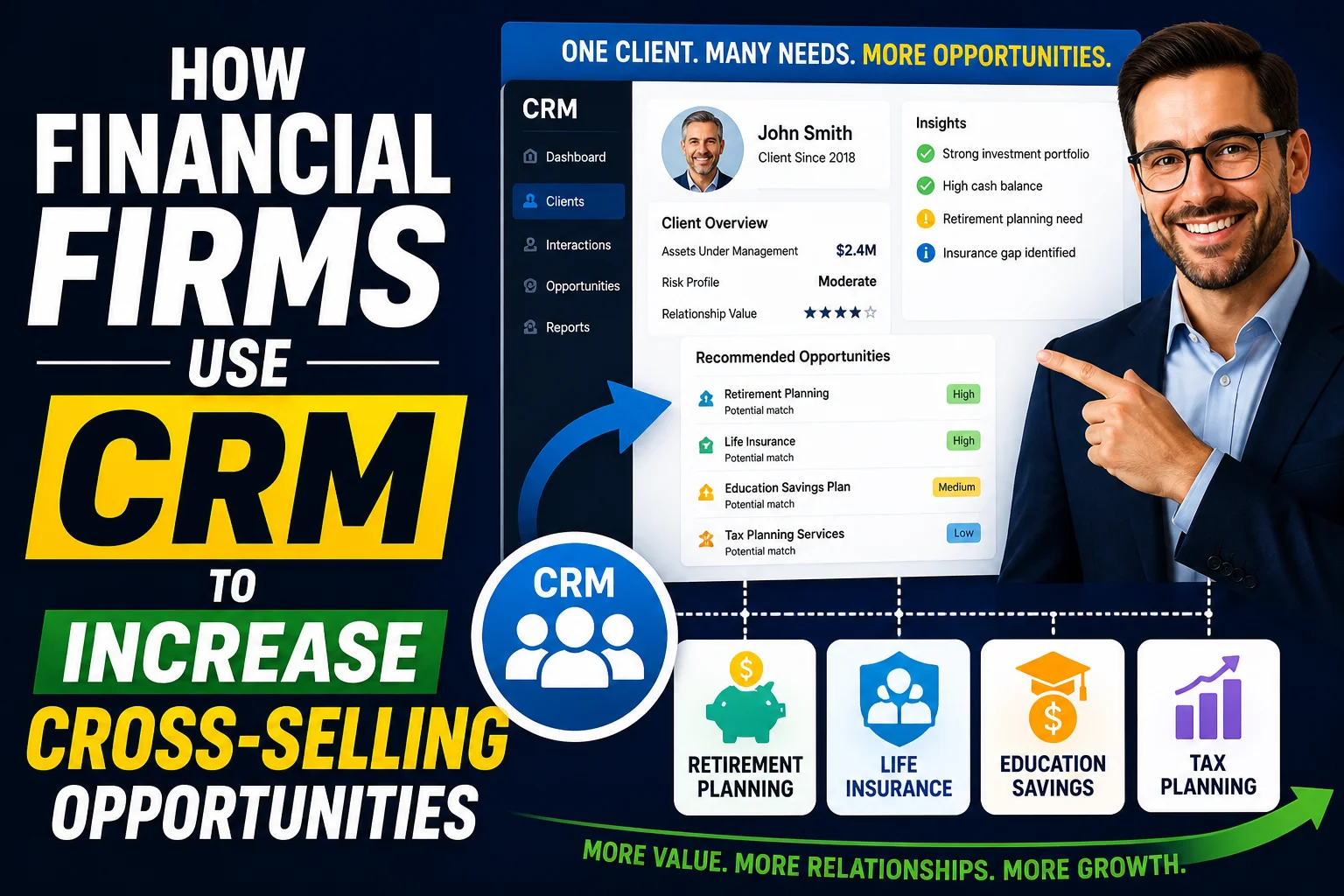
Discover how CRM helps financial businesses identify opportunities, upsell services, and maximize client lifetime value.
Cross-selling is one of the most effective ways for financial firms to grow revenue without constantly chasing new clients. The logic is simple. If a client already trusts you with one product, they are far more likely to consider additional services. But in practice, cross-selling is not easy. It requires timing, relevance, and a deep understanding of each client’s financial situation.
This is where CRM systems come in. Modern platforms like Salesforce CRM, HubSpot CRM, and Zoho CRM give financial firms the tools to track behavior, analyze data, and deliver personalized recommendations at scale.
Let’s break down how financial institutions actually use CRM to improve cross-selling and why it works.
Why Cross-Selling Matters in Financial Services
Financial services operate in a trust-driven environment. Clients often prefer to consolidate services with a single provider once they feel confident.
For example:
- A savings account holder may need a credit card
- A loan customer might be interested in insurance
- A wealth client could require tax advisory services
The cost of acquiring a new customer is significantly higher than selling to an existing one. Cross-selling increases customer lifetime value while strengthening relationships.
But poorly executed cross-selling can feel pushy and damage trust. CRM helps avoid that by making recommendations relevant instead of random.
Centralized Customer Data: The Foundation
At the core of any CRM system is data centralization. Financial firms deal with fragmented data across departments like loans, insurance, investments, and customer support. Without CRM, this data sits in silos.
CRM platforms unify:
- Transaction history
- Product ownership
- Communication records
- Behavioral insights
This unified view allows advisors to see the complete financial profile of a client.
For instance, if a CRM shows a customer recently took a home loan, it becomes logical to offer:
- Home insurance
- Property-related tax consultation
- Personal accident coverage
Without CRM, these opportunities are often missed.
Customer Segmentation for Smarter Targeting
Not every client should receive the same offer. CRM systems allow firms to segment customers based on specific attributes such as:
- Income level
- Age group
- Investment behavior
- Risk appetite
- Life stage events
Segmentation makes cross-selling more precise.
Example:
- Young professionals → credit cards, SIP investments
- Mid-career clients → insurance, retirement plans
- High-net-worth individuals → wealth management, estate planning
Instead of mass marketing, firms can deliver targeted campaigns that actually resonate.
Behavioral Insights and Predictive Analytics
Modern CRM tools go beyond storing data. They analyze it.
Using predictive analytics, CRM systems can identify patterns such as:
- When a client is likely to need a loan
- Which customers are ready to invest
- Who might churn without engagement
These insights help financial firms act at the right time.
For example:
If a client’s account balance steadily increases over months, CRM can flag them as a potential candidate for investment products.
This shifts cross-selling from reactive to proactive.
Personalized Communication at Scale
One of the biggest mistakes in cross-selling is generic communication. Clients can easily tell when they are receiving mass promotions.
CRM enables personalization by using:
- Customer names
- Product history
- Financial goals
- Previous interactions
Instead of:
“Check out our new insurance plan”
It becomes:
“Based on your recent home loan, you may benefit from a customized home insurance plan”
This level of personalization significantly increases conversion rates.
CRM also supports multi-channel communication:
- Email campaigns
- SMS alerts
- WhatsApp notifications
- In-app messaging
Consistency across channels ensures the message reaches the client effectively.
Tracking Customer Journeys
Cross-selling is not a one-step process. It involves multiple touchpoints.
CRM systems map the entire customer journey:
- Awareness
- Interest
- Consideration
- Decision
By tracking where a client stands, financial firms can tailor their approach.
Example:
- A client who clicked on an insurance email but didn’t respond may need a follow-up call
- A client who downloaded a brochure might be ready for a detailed consultation
This avoids both over-selling and under-engaging.
Relationship Manager Enablement
In many financial firms, relationship managers (RMs) play a critical role in cross-selling.
CRM empowers RMs by giving them:
- Real-time client insights
- Product recommendations
- Alerts for cross-sell opportunities
Instead of relying on memory or guesswork, RMs can approach clients with data-backed suggestions.
Example:
A CRM alert might say:
“Client eligible for pre-approved personal loan based on credit profile”
This allows the RM to initiate a meaningful conversation rather than a cold pitch.
Automation for Timely Engagement
Timing is everything in cross-selling.
CRM systems automate key triggers such as:
- Birthday or anniversary offers
- Loan completion follow-ups
- Investment maturity alerts
Automation ensures no opportunity is missed.
For example:
When a fixed deposit matures, CRM can automatically suggest reinvestment options or alternative products like mutual funds.
This keeps the client engaged without requiring manual tracking.
Cross-Department Collaboration
Financial firms often struggle with internal coordination. Different teams may approach the same client with unrelated offers.
CRM solves this by providing a shared platform where:
- Sales teams
- Support teams
- Advisory teams
all have access to the same information.
This prevents duplication and ensures a unified customer experience.
For instance:
If the insurance team already contacted a client, the investment team can adjust their approach accordingly.
Measuring Cross-Selling Performance
CRM systems also provide detailed analytics to measure effectiveness.
Key metrics include:
- Cross-sell conversion rate
- Revenue per customer
- Product penetration ratio
- Campaign performance
These insights help firms refine their strategies.
If a particular campaign underperforms, firms can quickly adjust messaging or targeting.
Data-driven decisions replace guesswork.
Compliance and Trust
In financial services, compliance is critical. Mis-selling can lead to serious consequences.
CRM systems help maintain compliance by:
- Recording all customer interactions
- Tracking consent and preferences
- Ensuring suitability checks
This ensures that cross-selling efforts are ethical and aligned with regulations.
Clients feel more confident when recommendations are transparent and well-documented.
Real-World Example
Consider a retail banking scenario:
A customer opens a salary account.
CRM tracks:
- Monthly income credits
- Spending patterns
- Savings behavior
Based on this data, the system suggests:
- Credit card with relevant benefits
- Investment plan for surplus income
- Insurance for financial protection
Each recommendation is timed and personalized.
This increases the likelihood of acceptance while improving the customer experience.
Challenges Without CRM
To understand the value, it helps to look at what happens without CRM:
- Missed cross-selling opportunities
- Irrelevant product recommendations
- Poor customer experience
- Data silos across departments
- Inefficient manual tracking
In short, firms lose both revenue and trust.
Future of CRM in Cross-Selling
CRM is evolving rapidly with technologies like:
- Artificial intelligence
- Machine learning
- Advanced data analytics
Future systems will:
- Predict needs even earlier
- Offer hyper-personalized solutions
- Automate complex decision-making
Financial firms that adopt these capabilities will have a strong competitive advantage.
